St. Peter's Cathedral Complex

Why it's listed
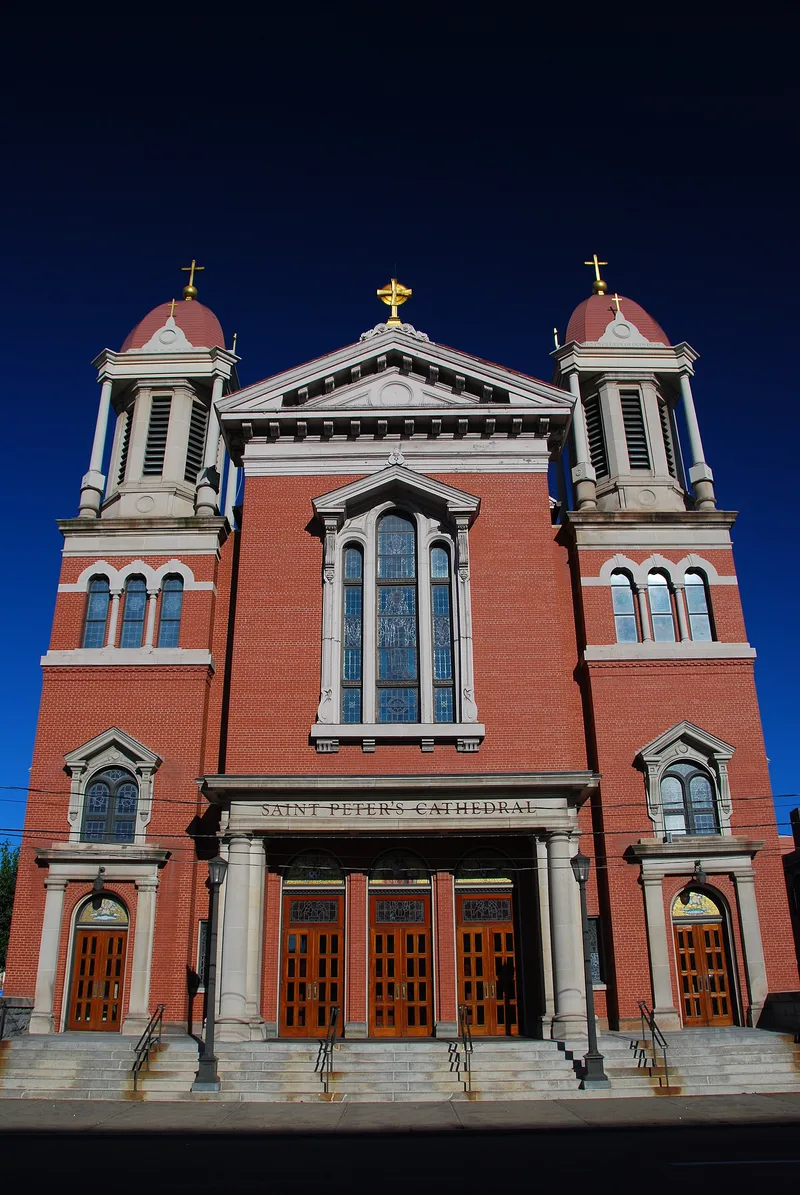
On Wyoming Avenue in downtown Scranton, three brick buildings form a single street front: St. Peter's Cathedral, completed in 1867 to designs by Joel Amsden, the Cathedral Rectory of 1908 and the Cathedral Convent. The cathedral, built of red brick with limestone trim and a clay tile roof, has two bell towers and a limestone pediment, and seated 2,300 people. Later renovations in 1883, 1921, 1934 and 1966 altered its entrance, towers and interior. The rectory, reputed to be the work of Lewis Hancock, has golden oak interiors and a limestone base. The convent is the surviving building of St. Thomas College, the forerunner of the University of Scranton. The buildings are regarded as fine examples of the Romanesque Revival style in the region, and they are listed for their architecture and for their link to the diocese and the college.
Significance in brief: The nomination argues the complex is significant as the mother church for 237 churches in northeastern Pennsylvania, as the Cathedral Convent is all that remains of St. Thomas College, and for the architectural quality of the three buildings as fine examples of the Romanesque Revival style. It also notes the complex's contribution to the streetscape with its landscaped, human-scale setting.
Machine-generated summary. This summary was generated by a language model from the official nomination document and has not been reviewed line by line by an editor. It may contain errors. Check the source document before relying on any detail. Source: nomination document (PDF) · National Archives catalog entry. NRHP reference 76001645, listed July 19, 1976. Summary generated October 2026 (model claude-haiku-5-5, prompt v1.1-2026-10-29, confidence medium).
Key facts
| Address | 315 Wyoming Ave., Scranton |
|---|---|
| County | Lackawanna County |
| Listed | July 19, 1976 |
| Reference number | 76001645 |
| Resource type | Building |
| Period of significance | 1800-1899 |
| Architectural style | Romanesque Revival |
| Criteria |
|
| Areas of significance | Education, Architecture, Religion |
| Level of significance | Local |
| Status (as stated in the nomination) | Restoration and preservation work was being performed on the rectory's interior and exterior at the time of the nomination. |
| Acreage | 1.3 |
| Coordinates | 41.41069, -75.66343 (NPS GIS) |
What listing means for this property
Religious properties are listed for their architectural or historical significance, not their religious use. Listing is honorary and does not restrict the congregation's use of the building. The federal rehabilitation credit is generally unavailable unless part of the building is income-producing; some state programmes and preservation grants do cover religious buildings. Federal funding or permits trigger Section 106 review.
General information, not legal or tax advice. Rules change; confirm with your State Historic Preservation Office or a qualified adviser.
Sources and further reading
- National Park Service, National Register of Historic Places database (snapshot May 2026), reference 76001645.
- Nomination form (PDF, National Archives) — catalog entry
- Wikipedia article (used for cross-checking only; text not reproduced here)
- Wikidata Q2942438
- This listing as JSON
Last updated October 2026. Found an error? See the editorial policy for how to report it.