Lackawanna Iron and Coal Company Furnace
Also known as: Lackawanna Iron & Steel Co.; Scranton Iron Furnaces

Why it's listed
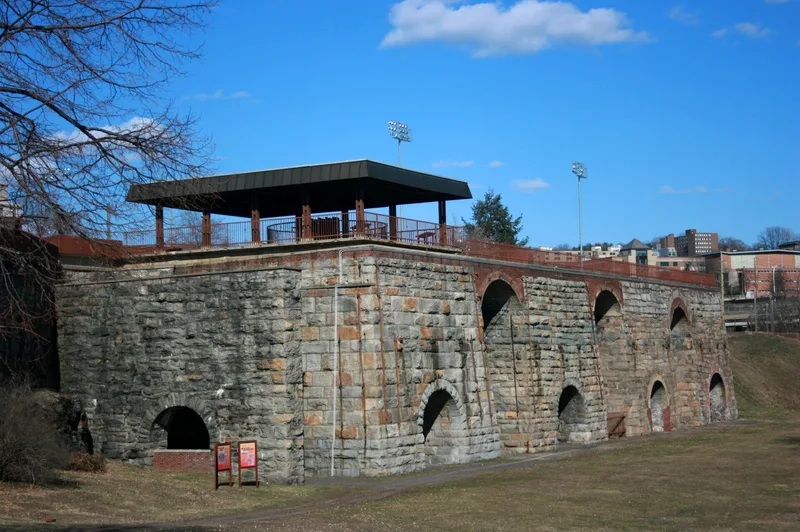
Four stone blast furnaces stand in a row on a hillside above Roaring Brook in downtown Scranton, Pennsylvania. The two eastern stacks were built around 1848 and 1849, and the third and fourth were added about 1852 and 1857. Each stack is about 40 feet high, and the masonry arches that join them share hot blast equipment, a linked arrangement that is rare and that the complex is valued for. The furnaces opened under William Henry's direction in the 1840s and became part of the Lackawanna Iron and Coal Company, which later produced T rails for railroads, including the New York and Erie. Most of the surrounding ironworks was dismantled in 1903 and 1904, leaving the stone stacks as the surviving remnant of the operation. The furnaces were stabilized in 1969 and are now administered as a public site.
Significance in brief: The nomination argues the furnaces represent an important statewide industry, the anthracite iron and rail production that supplied railroads, and that the complex is unusual engineering because the furnaces were linked in a serial arrangement to share hot blast equipment. Only these linked furnaces remain intact. The individual furnaces are comparable to other anthracite furnaces, so the distinction lies in the complex's configuration.
Machine-generated summary. This summary was generated by a language model from the official nomination document and has not been reviewed line by line by an editor. It may contain errors. Check the source document before relying on any detail. Source: nomination document (PDF) · National Archives catalog entry. NRHP reference 91001126, listed September 6, 1991. Summary generated October 2026 (model claude-haiku-5-5, prompt v1.1-2026-10-29, confidence high).
Key facts
| Address | 159 Cedar Ave., Scranton |
|---|---|
| County | Lackawanna County |
| Listed | September 6, 1991 |
| Reference number | 91001126 |
| Resource type | Structure |
| Period of significance | 1848-1903 |
| Criteria |
|
| Areas of significance | Industry, Engineering |
| Level of significance | State |
| Status (as stated in the nomination) | The furnace stacks were stabilized in 1969 and later acquired by the Commonwealth of Pennsylvania; a visitors facility, pavilion, parking and interpretive signs were added. |
| Acreage | 3.8 |
| Coordinates | 41.40457, -75.66211 (NPS GIS) |
What listing means for this property
For an income-producing building, listing (individually or as a contributing building in a district) is the gateway to the 20% federal rehabilitation tax credit on qualified rehabilitation costs, often stackable with state credits. Work claiming the credit must follow the Secretary of the Interior's Standards and be approved in advance.
Listing does not restrict a private owner acting without federal money or permits; where federal funding or licensing is involved, Section 106 review applies.
General information, not legal or tax advice. Rules change; confirm with your State Historic Preservation Office or a qualified adviser.
Sources and further reading
- National Park Service, National Register of Historic Places database (snapshot May 2026), reference 91001126.
- Nomination form (PDF, National Archives) — catalog entry
- Wikipedia article (used for cross-checking only; text not reproduced here)
- Wikidata Q7438748
- This listing as JSON
Last updated October 2026. Found an error? See the editorial policy for how to report it.