Lackawanna Avenue Commercial Historic District
Also known as: Scranton Commercial Historic District
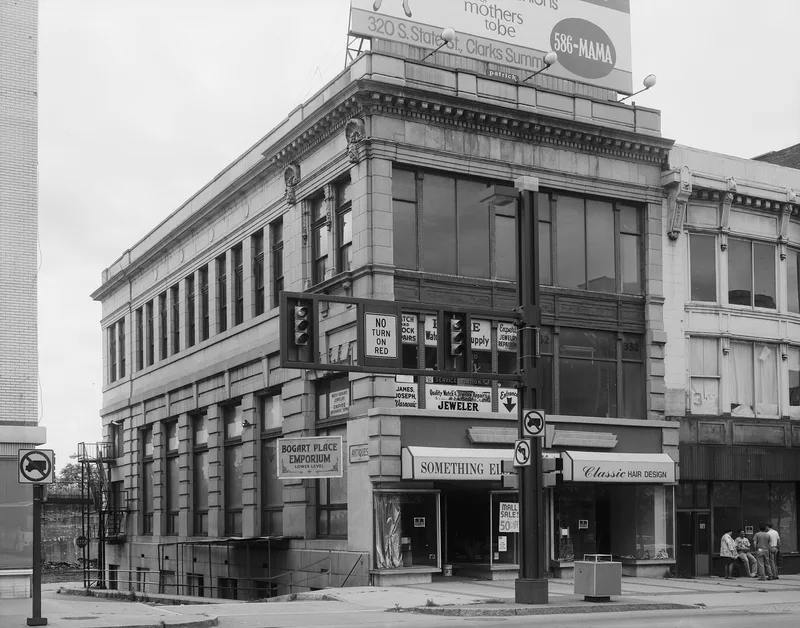

Why it's listed
Lackawanna Avenue in downtown Scranton is a commercial district of three-and-one-half blocks plus one adjoining square block, lined mostly by three- and four-story buildings of brick, stone, tile and stucco, most dating from the late nineteenth century. The buildings were erected as Scranton grew into a center of the anthracite coal and manufacturing industries. Scranton's population rose from fewer than 10,000 in the early 1860s to over 35,000 by 1870, and the Avenue became its commercial heart, with banks, hotels, shops and offices. Upper floors retain their Renaissance Revival, Romanesque Revival and Commercial character, with projecting cornices, pedimented parapets bearing dates and initials, and corbelled blind arcading. Along Wyoming and North Washington Streets, larger buildings built for banks, corporate offices and department stores reflect the city's later growth. The district is significant for documenting that period of prosperity.
Significance in brief: The district is argued to be significant as the commercial core of Scranton during its growth as a center of the anthracite coal and manufacturing industries between 1860 and 1930. It holds a number of fine late nineteenth-century commercial architectural examples, including Renaissance Revival, Romanesque Revival and Commercial styles, and reflects the prosperity of the city in that period.
Machine-generated summary. This summary was generated by a language model from the official nomination document and has not been reviewed line by line by an editor. It may contain errors. Check the source document before relying on any detail. Source: nomination document (PDF) · National Archives catalog entry. NRHP reference 83004215, listed November 10, 1983. Summary generated October 2026 (model claude-haiku-5-5, prompt v1.1-2026-10-29, confidence medium).
Key facts
| Address | Roughly bounded by Adams, Franklin, Bogart Pl., and Spruce Sts., Scranton |
|---|---|
| County | Lackawanna County |
| Listed | November 10, 1983 |
| Reference number | 83004215 |
| Resource type | District |
| Period of significance | 1860-1920 |
| Architectural style | Renaissance Revival, Romanesque Revival, Commercial, Italianate, Gothic Revival, Richardson Romanesque, Neo Classicism, Art Deco |
| Criteria |
|
| Areas of significance | Commerce, Architecture |
| Level of significance | Local |
| Status (as stated in the nomination) | Many first-floor storefronts have been altered for commercial purposes, while upper floors are generally intact; original commercial use of the buildings remains consistent with the historic use. |
| Acreage | 18.5 |
| Coordinates | 41.40737, -75.65974 (NPS GIS) |
What listing means for this property
This is a historic district. Buildings within its boundary are either contributing (they add to the district's significance) or non-contributing. Owners of contributing income-producing buildings can claim the 20% federal rehabilitation tax credit; homeowners should look at state credits. National Register districts impose no design review by themselves; a local historic district ordinance, if one exists, does (the difference explained).
General information, not legal or tax advice. Rules change; confirm with your State Historic Preservation Office or a qualified adviser.
Sources and further reading
- National Park Service, National Register of Historic Places database (snapshot May 2026), reference 83004215.
- Nomination form (PDF, National Archives) — catalog entry
- Wikipedia article (used for cross-checking only; text not reproduced here)
- Wikidata Q6468684
- This listing as JSON
Last updated October 2026. Found an error? See the editorial policy for how to report it.