Sharples Separator Works
Also known as: Gumas Warehouse; Kauffman Warehouse

Why it's listed
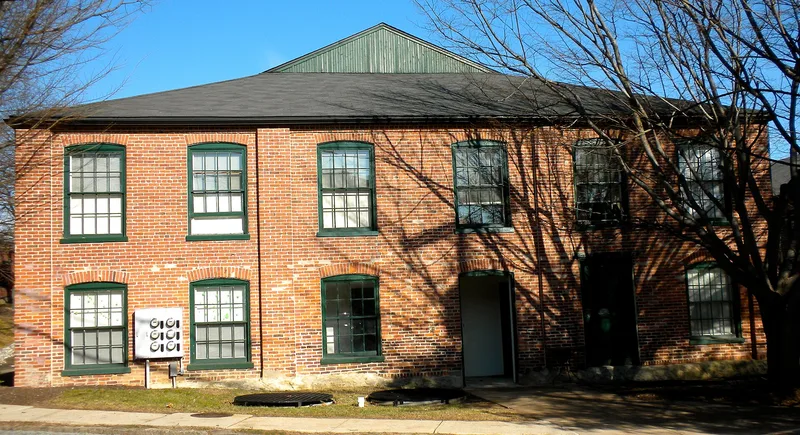
West Chester's largest mechanized industrial complex, the Sharples Separator Works, grew from a machine shop on North Walnut Street opened by Philip M. Sharples in 1881. After moving in 1890 to a site near the Pennsylvania Railroad, the company expanded through 1909 into a cluster of nineteen units, most built of brick with timber post-and-beam frames. The works produced the Sharples Tubular Centrifugal Separator, the first American-invented and American-made cream separating machine, and the nomination argues it provided the prototype for the later Sharples-Stokes industrial centrifuge. The complex is noted for its decorative brickwork, corbelled courses and arrangement of machine shops around a central yard. Operations ended in receivership in 1933, and most of the plant was later adapted for warehousing and small industry. The Sharples Corporation continued elsewhere under successor firms.
Significance in brief: The nomination argues the works was the largest mechanized industrial environment built in the West Chester area and the site where the first American-invented and American-made cream separator was produced. It states the works were the precursor of the Sharples-Stokes centrifuge and that the surviving complex, with its distinctive brickwork and arrangement of units, is an unusual and intact example of turn-of-the-century industrial design.
Machine-generated summary. This summary was generated by a language model from the official nomination document and has not been reviewed line by line by an editor. It may contain errors. Check the source document before relying on any detail. Source: nomination document (PDF) · National Archives catalog entry. NRHP reference 84003214, listed June 28, 1984. Summary generated October 2026 (model claude-haiku-5-5, prompt v1.1-2026-10-29, confidence medium).
Key facts
| Address | N. Franklin and Evans Sts., West Chester |
|---|---|
| County | Chester County |
| Listed | June 28, 1984 |
| Reference number | 84003214 |
| Resource type | Building |
| Period of significance | 1800-1939 |
| Areas of significance | Industry, Invention |
| Level of significance | Local |
| Status (as stated in the nomination) | Some buildings are vacant and others are used for warehousing or small industry; Building 14 is described as structurally unstable. |
| Acreage | 5 |
| Coordinates | 39.96501, -75.60225 (NPS GIS) |
What listing means for this property
For an income-producing building, listing (individually or as a contributing building in a district) is the gateway to the 20% federal rehabilitation tax credit on qualified rehabilitation costs, often stackable with state credits. Work claiming the credit must follow the Secretary of the Interior's Standards and be approved in advance.
Listing does not restrict a private owner acting without federal money or permits; where federal funding or licensing is involved, Section 106 review applies.
General information, not legal or tax advice. Rules change; confirm with your State Historic Preservation Office or a qualified adviser.
Sources and further reading
- National Park Service, National Register of Historic Places database (snapshot May 2026), reference 84003214.
- Nomination form (PDF, National Archives) — catalog entry
- Wikipedia article (used for cross-checking only; text not reproduced here)
- Wikidata Q7490406
- This listing as JSON
Last updated October 2026. Found an error? See the editorial policy for how to report it.