Pennypacker, Matthias, Farm
Also known as: Tinker Dam Farm

Why it's listed
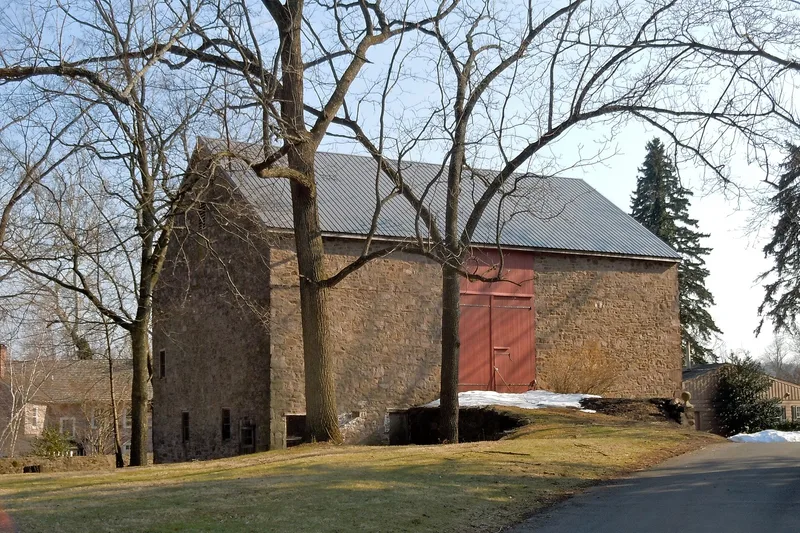
A two-section stone farmhouse on Mill Road in Phoenixville, Chester County, built of rubble masonry with pebble-dash stucco and a slate roof. The older west section predates the Revolution, and a three-story main block with a datestone of 1830 was added later. The property includes a 1805 stone bank barn, a smoke house, spring house, and a dug well. It was the core of a mill-farm complex begun in 1774 by Matthias Pennypacker, a Mennonite bishop who sided with the Colonists. In the winter of 1777-1778, during the Valley Forge encampment, a company of horse was stationed at the house, the orchard served as a parade ground, and the barn held powder. The grist and saw mills on Pickering Creek were later demolished, the grist mill in 1929 when a water company dam flooded its site. The house passed out of the family in 1934.
Significance in brief: The nomination argues the property is the surviving remnant of an outstanding mill-farm complex developed by the Pennypacker family from 1774. Its significance rests on its associations with the Valley Forge encampment in the winter of 1777-1778 and with the Pennypacker family, including Governor Samuel Pennypacker.
Machine-generated summary. This summary was generated by a language model from the official nomination document and has not been reviewed line by line by an editor. It may contain errors. Check the source document before relying on any detail. Source: nomination document (PDF) · National Archives catalog entry. NRHP reference 77001154, listed December 27, 1977. Summary generated October 2026 (model claude-haiku-5-5, prompt v1.1-2026-10-29, confidence medium).
Key facts
| Address | S of Phoenixville on White Horse Rd., Phoenixville |
|---|---|
| County | Chester County |
| Listed | December 27, 1977 |
| Reference number | 77001154 |
| Resource type | Building |
| Period of significance | Circa 1780's, Circa 1830 |
| Architectural style | Georgian |
| Areas of significance | Military, Architecture |
| Level of significance | Local |
| Status (as stated in the nomination) | The house passed out of the family in 1934; the saw mill was demolished in 1885 and the grist mill in 1929. |
| Acreage | 5.9 |
| Coordinates | 40.11056, -75.50712 (NPS GIS) |
What listing means for this property
National Register listing is honorary for a privately owned home: it does not by itself restrict what an owner may do with their own money, and it does not require public access. Restrictions come from local landmark or historic-district ordinances, which are separate (how they differ).
Owner-occupied houses are not eligible for the 20% federal rehabilitation tax credit, which applies to income-producing buildings, but many states offer credits for homeowners. Listing also opens the door to preservation easements and to buying a plaque. Start with what listing means for homeowners, renovating a listed house and selling one.
General information, not legal or tax advice. Rules change; confirm with your State Historic Preservation Office or a qualified adviser.
Sources and further reading
- National Park Service, National Register of Historic Places database (snapshot May 2026), reference 77001154.
- Nomination form (PDF, National Archives) — catalog entry
- Wikipedia article (used for cross-checking only; text not reproduced here)
- Wikidata Q6791591
- This listing as JSON
Last updated October 2026. Found an error? See the editorial policy for how to report it.