Moore Hall

Why it's listed
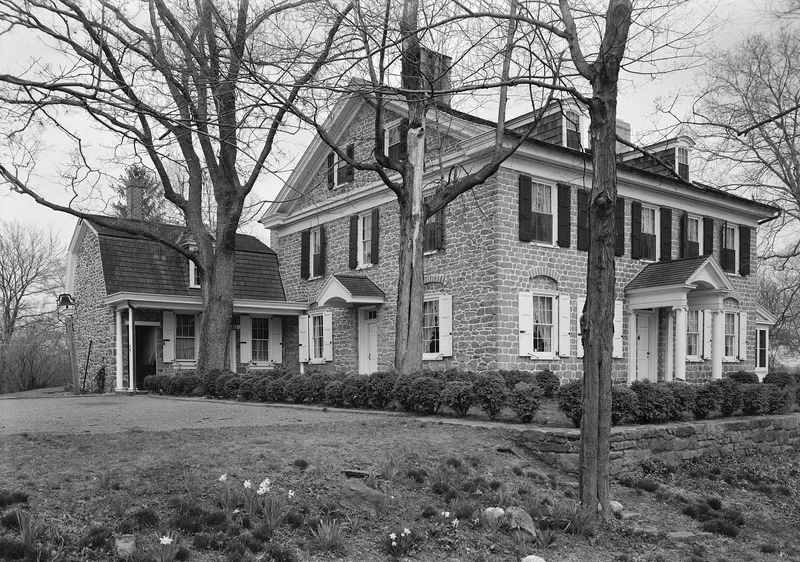
Moore Hall is a two-and-one-half story fieldstone house in Phoenixville, Chester County, built in the mid-eighteenth century by William Moore on land given to him in 1729 by his father, John, Collector of the port of Philadelphia. The front is coursed fieldstone, graded from larger stones at the foundation to smaller at the eaves, and the interior retains wide board floors, Doric reeded columns, and a carved marble fireplace. Moore served in the Provincial Assembly and as a judge of the Chester County Court, and he was jailed in Philadelphia in 1758 after a dispute with the Assembly. During the winter of 1778 the house was used by the Continental Army at Valley Forge, serving as headquarters for Colonel Clement Biddle. A Committee of Congress met there for three months while deciding on George Washington as Commander-in-Chief. The house was later the summer residence of Governor Samuel Whitaker Pennypacker. Restoration work in the late 1930s altered parts of the house and kitchen wing.
Significance in brief: The house is regarded as an especially fine Georgian house with a highly developed sense of formal proportion and detailing that is rare for its period and area. It is also tied to Revolutionary-era events, including use by the Continental Army at Valley Forge in 1778 and a Committee of Congress meeting there, and to colonial disputes involving its builder, a Chester County judge and Assembly opponent.
Machine-generated summary. This summary was generated by a language model from the official nomination document and has not been reviewed line by line by an editor. It may contain errors. Check the source document before relying on any detail. Source: nomination document (PDF) · National Archives catalog entry. NRHP reference 74001771, listed November 19, 1974. Summary generated October 2026 (model claude-haiku-5-5, prompt v1.1-2026-10-29, confidence high).
Key facts
| Address | E of Phoenixville on Valley Forge Rd., Schuylkill Township, Phoenixville |
|---|---|
| County | Chester County |
| Listed | November 19, 1974 |
| Reference number | 74001771 |
| Resource type | Building |
| Period of significance | 18th Century |
| Architectural style | Georgian |
| Criteria |
|
| Areas of significance | Politics/Government, Architecture |
| Level of significance | Local |
| Status (as stated in the nomination) | Restored in the late 1930s; the document describes its condition as excellent and at its original site. |
| Acreage | 1.5 |
| Coordinates | 40.12283, -75.48315 (NPS GIS) |
What listing means for this property
National Register listing is honorary for a privately owned home: it does not by itself restrict what an owner may do with their own money, and it does not require public access. Restrictions come from local landmark or historic-district ordinances, which are separate (how they differ).
Owner-occupied houses are not eligible for the 20% federal rehabilitation tax credit, which applies to income-producing buildings, but many states offer credits for homeowners. Listing also opens the door to preservation easements and to buying a plaque. Start with what listing means for homeowners, renovating a listed house and selling one.
General information, not legal or tax advice. Rules change; confirm with your State Historic Preservation Office or a qualified adviser.
Sources and further reading
- National Park Service, National Register of Historic Places database (snapshot May 2026), reference 74001771.
- Nomination form (PDF, National Archives) — catalog entry
- Wikipedia article (used for cross-checking only; text not reproduced here)
- Wikidata Q15255968
- This listing as JSON
Last updated October 2026. Found an error? See the editorial policy for how to report it.