Hoffman, George, House

Why it's listed
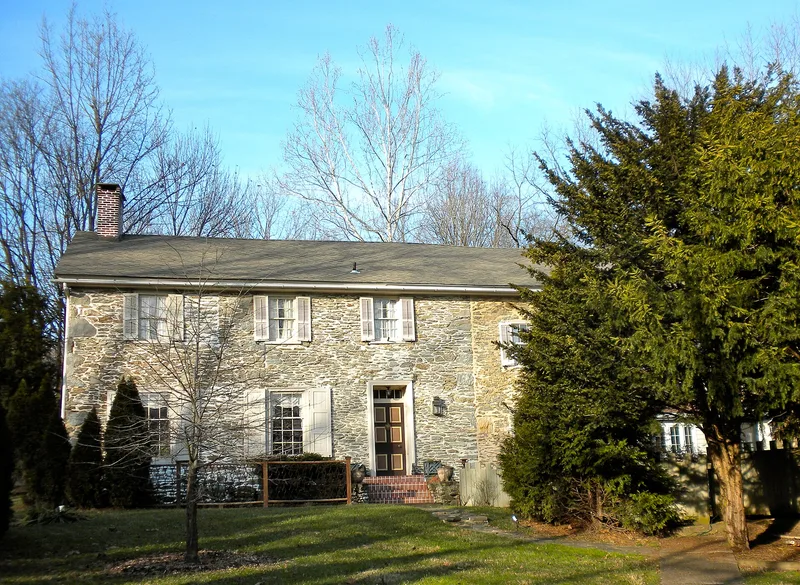
Set in a small valley drained by Broad Run on Grove Road, the Hoffman House grew over more than a century from a modest two-story stone house, about 16 by 20 feet, with an attached one-story log kitchen. George Hoffman, who had emigrated from Germany and served as a teamster under General Braddock in 1755, bought 275 acres in 1772 and built the homestead. Later sections were added to the west and center, probably around 1805 and in the mid-19th century, and a frame addition was built to the east around 1900. Sections share a common roofline and pegged rafters marked with Roman numerals, and an earlier roof line is visible in the stonework. The house remained with Hoffman descendants until 1902. Its clear sequence of additions and external integrity make it an unusual and well-documented example of vernacular building in Chester County.
Significance in brief: The nomination argues the house is a fine example of an additive vernacular dwelling, notable for the way it grew from a single small stone and log building into a long house through successive additions. Its external integrity and unity are cited, and the progression of additions is described as apparently unique to the township. The form also suggests it may be the southernmost evidence of German occupation in Chester County.
Machine-generated summary. This summary was generated by a language model from the official nomination document and has not been reviewed line by line by an editor. It may contain errors. Check the source document before relying on any detail. Source: nomination document (PDF) · National Archives catalog entry. NRHP reference 84003272, listed August 2, 1984. Summary generated October 2026 (model claude-haiku-5-5, prompt v1.1-2026-10-29, confidence medium).
Key facts
| Address | 1311 Grove Rd., West Whiteland |
|---|---|
| County | Chester County |
| Listed | August 2, 1984 |
| Reference number | 84003272 |
| Resource type | Building |
| Period of significance | 1700-1799 |
| Architectural style | Additive Vernacular |
| Criteria |
|
| Areas of significance | Architecture |
| Level of significance | Local |
| Acreage | 1.5 |
| Coordinates | 39.99498, -75.63221 (NPS GIS) |
What listing means for this property
National Register listing is honorary for a privately owned home: it does not by itself restrict what an owner may do with their own money, and it does not require public access. Restrictions come from local landmark or historic-district ordinances, which are separate (how they differ).
Owner-occupied houses are not eligible for the 20% federal rehabilitation tax credit, which applies to income-producing buildings, but many states offer credits for homeowners. Listing also opens the door to preservation easements and to buying a plaque. Start with what listing means for homeowners, renovating a listed house and selling one.
General information, not legal or tax advice. Rules change; confirm with your State Historic Preservation Office or a qualified adviser.
Sources and further reading
- National Park Service, National Register of Historic Places database (snapshot May 2026), reference 84003272.
- Nomination form (PDF, National Archives) — catalog entry
- Wikipedia article (used for cross-checking only; text not reproduced here)
- Wikidata Q5540660
- This listing as JSON
Last updated October 2026. Found an error? See the editorial policy for how to report it.