Charlestown Village Historic District
Also known as: Charlestown Village

Why it's listed
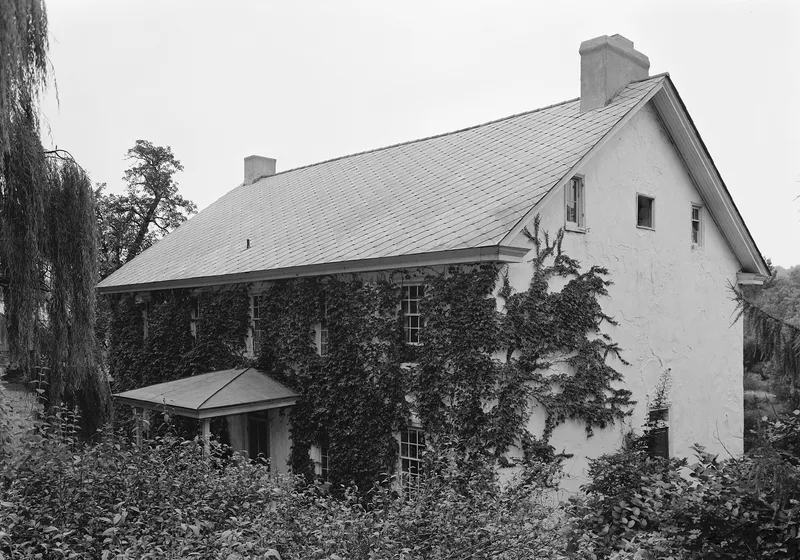
Charlestown Village grew up around a mill beside Pickering Creek in what is now Phoenixville, Chester County, Pennsylvania. Joseph (Job) Harvey, a fuller, bought the land in 1724 and built a fulling mill on the west bank, and the village later developed along Church and Pickering Dam Roads. Most of its residences are two and a half stories high, built of fieldstone covered with stucco, and set on large lots in lineal rows facing the creek or Charlestown Road. The Harvey House began as a log cabin around 1725 and was enlarged in stone in the 1740s. The mill passed through several owners, switching from flax to wool and later cotton, and was rebuilt after fires in 1819 and 1861. The general store and Town Hall, built with a Mansard roof in 1868, served as the village's social center. The district is significant for its mill-based economy and for its largely intact early village form.
Significance in brief: The village grew around a mill site used for almost two hundred years and served as the commercial and social center of the surrounding agricultural area. Its 18th and 19th century houses share a consistent building form, massing and detailing, which gives the village a strong sense of unity. The nomination also cites its association with local industry and community life, including the general store, Town Hall, churches and school.
Machine-generated summary. This summary was generated by a language model from the official nomination document and has not been reviewed line by line by an editor. It may contain errors. Check the source document before relying on any detail. Source: nomination document (PDF) · National Archives catalog entry. NRHP reference 78002374, listed May 16, 1978. Summary generated October 2026 (model claude-haiku-5-5, prompt v1.1-2026-10-29, confidence medium).
Key facts
| Address | SW of Phoenixville on Charlestown Rd., Charlestown Township, Phoenixville |
|---|---|
| County | Chester County |
| Listed | May 16, 1978 |
| Reference number | 78002374 |
| Resource type | District |
| Period of significance | 1700-1899 |
| Criteria |
|
| Areas of significance | Industry, Commerce, Art |
| Level of significance | State |
| Status (as stated in the nomination) | The mill, described as now vacant, has been converted to a grist mill and later a combination grist mill, cider mill and garage. |
| Acreage | 126.1 |
| Coordinates | 40.10243, -75.55567 (NPS GIS) |
What listing means for this property
This is a historic district. Buildings within its boundary are either contributing (they add to the district's significance) or non-contributing. Owners of contributing income-producing buildings can claim the 20% federal rehabilitation tax credit; homeowners should look at state credits. National Register districts impose no design review by themselves; a local historic district ordinance, if one exists, does (the difference explained).
Noted as vacant in the nomination. Nomination documents can be decades old; current status may differ. If you are considering buying an empty listed property, read the due-diligence checklist.
General information, not legal or tax advice. Rules change; confirm with your State Historic Preservation Office or a qualified adviser.
Sources and further reading
- National Park Service, National Register of Historic Places database (snapshot May 2026), reference 78002374.
- Nomination form (PDF, National Archives) — catalog entry
- Wikipedia article (used for cross-checking only; text not reproduced here)
- Wikidata Q5084232
- This listing as JSON
Last updated October 2026. Found an error? See the editorial policy for how to report it.