Cedarcroft
Also known as: Bayard Taylor House

Why it's listed
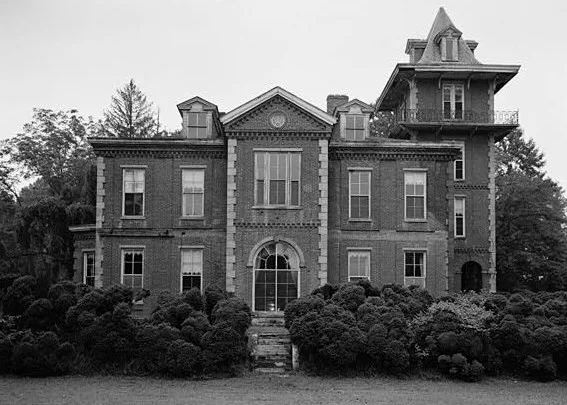
Cedarcroft is a large brick house near Kennett Square, Pennsylvania, with a four-and-a-half story tower projecting from its front elevation and an entrance porch of five round arches. Writer Bayard Taylor laid its cornerstone in 1859 and moved in the following year, and it remained his home until 1874, when he moved to New York. Taylor wrote many works here, and the house is valued as a reflection of his character and of the taste of his age. Its lavish scale and design are cited as expressions of the blend of romantic and materialistic impulses of mid-nineteenth-century America. The interior retains parquet floors, moulded ceilings, marble mantles and woodwork believed to be original, and two large mirrors said to date from Taylor's time. Taylor was also buried in a time capsule-style zinc box beneath the cornerstone, containing poems by himself and R. H. Stoddard. The house was later owned by several families and, by the early 1970s, was vacant.
Significance in brief: The nomination argues that the house is a direct expression of Taylor's character and of the romantic and materialistic outlook of mid-nineteenth-century America. It is described as a striking memorial to Taylor and his era, and it is noted as the scene of much of his writing. Its relatively unaltered interior is cited as a further reason for its importance.
Machine-generated summary. This summary was generated by a language model from the official nomination document and has not been reviewed line by line by an editor. It may contain errors. Check the source document before relying on any detail. Source: nomination document (PDF) · National Archives catalog entry. NRHP reference 71000693, listed November 11, 1971. Summary generated October 2026 (model claude-haiku-5-5, prompt v1.1-2026-10-29, confidence medium).
Key facts
| Address | N of Kennett Sq., Kennett Square |
|---|---|
| County | Chester County |
| Listed | November 11, 1971 |
| Reference number | 71000693 |
| Resource type | Building |
| Period of significance | 1859-1874 |
| Areas of significance | Literature |
| Level of significance | National |
| National Historic Landmark | Yes, designated November 11, 1971 |
| Status (as stated in the nomination) | The house is said to be in good condition structurally but in need of many minor interior repairs; a 1972 letter says it was vacant and on the market. |
| Coordinates | 39.86011, -75.71879 (NPS GIS) |
What listing means for this property
National Register listing is honorary: it recognises significance and does not restrict what a private owner may do without federal money or permits. It unlocks the 20% federal rehabilitation tax credit for income-producing buildings, state credits in many states, and Section 106 review when federal agencies are involved. See what listing means in practice.
Noted as vacant in the nomination. Nomination documents can be decades old; current status may differ. If you are considering buying an empty listed property, read the due-diligence checklist.
General information, not legal or tax advice. Rules change; confirm with your State Historic Preservation Office or a qualified adviser.
Sources and further reading
- National Park Service, National Register of Historic Places database (snapshot May 2026), reference 71000693.
- Nomination form (PDF, National Archives) — catalog entry
- Wikipedia article (used for cross-checking only; text not reproduced here)
- Wikidata Q5056970
- This listing as JSON
Last updated October 2026. Found an error? See the editorial policy for how to report it.