Summerseat
Also known as: George Clymer House; Thomas Barclay House; Summerseat School

Why it's listed
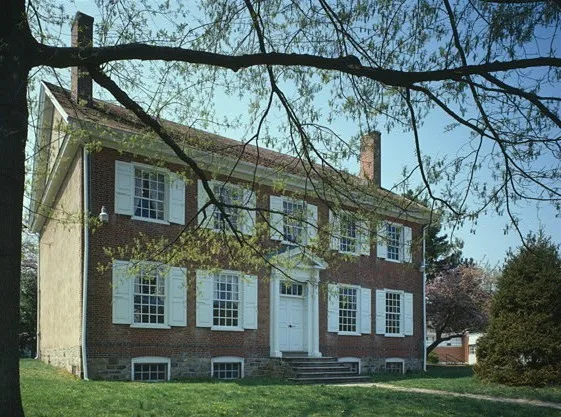
Summerseat is a two-story brick and stone Georgian house in Morrisville, Pennsylvania, built over an elevated basement in the 1770s for Thomas Barclay, a Philadelphia merchant. The five-bay house has gauged brick arches, shuttered windows, and a central hall running through to the rear, with a fireplace in each of its four rooms on each floor. It was acquired in 1806 by George Clymer, a Pennsylvania Signer of the Declaration of Independence, who had served three terms in the Continental Congress and later sat in the first United States Congress. Clymer lived here until his death in 1813, and the house is regarded as the best surviving link to his later life. The house was restored in 1931 and adapted as a school administrative building in 1935. Its walls, floors and some woodwork are described as original, and it remains in educational use today.
Significance in brief: The nomination argues the house is significant for its association with George Clymer, a Signer of the Declaration of Independence for Pennsylvania, who acquired it in 1806 and lived there until his death in 1813. The house is also cited as an example of Georgian architecture with original walls, floor and some woodwork.
Machine-generated summary. This summary was generated by a language model from the official nomination document and has not been reviewed line by line by an editor. It may contain errors. Check the source document before relying on any detail. Source: nomination document (PDF) · National Archives catalog entry. NRHP reference 71000685, listed July 17, 1971. Summary generated October 2026 (model claude-haiku-5-5, prompt v1.1-2026-10-29, confidence high).
Key facts
| Address | Clymer St. and Morris Ave., Morrisville |
|---|---|
| County | Bucks County |
| Listed | July 17, 1971 |
| Reference number | 71000685 |
| Resource type | Building |
| Period of significance | 1806-1813 |
| Architectural style | Georgian |
| Areas of significance | Politics/Government |
| Level of significance | National |
| National Historic Landmark | Yes, designated July 17, 1971 |
| Status (as stated in the nomination) | Restored in 1931 and renovated for use as a school administrative building in 1935; the document states it is in good condition and still used for educational purposes. |
| Acreage | 2 |
| Coordinates | 40.20816, -74.77962 (NPS GIS) |
What listing means for this property
National Register listing is honorary: it recognises significance and does not restrict what a private owner may do without federal money or permits. It unlocks the 20% federal rehabilitation tax credit for income-producing buildings, state credits in many states, and Section 106 review when federal agencies are involved. See what listing means in practice.
General information, not legal or tax advice. Rules change; confirm with your State Historic Preservation Office or a qualified adviser.
Sources and further reading
- National Park Service, National Register of Historic Places database (snapshot May 2026), reference 71000685.
- Nomination form (PDF, National Archives) — catalog entry
- Wikipedia article (used for cross-checking only; text not reproduced here)
- Wikidata Q7637659
- This listing as JSON
Last updated October 2026. Found an error? See the editorial policy for how to report it.