Grundy Mill Complex
Also known as: Bristol Worsted Mills

Why it's listed
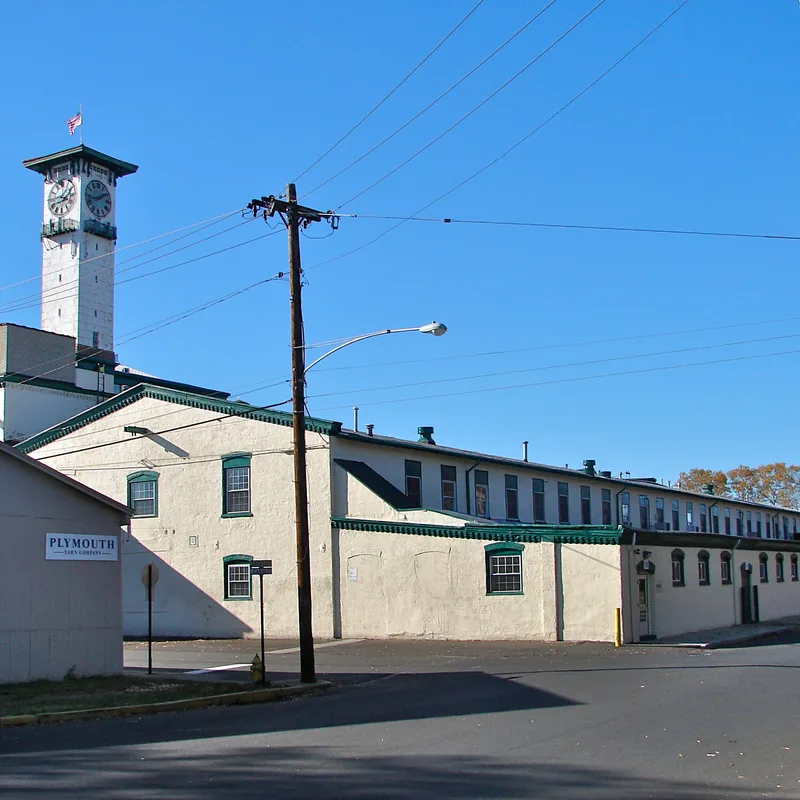
Industrial complex in Bristol Borough, Bucks County, built between 1876 and 1915 on land near the Delaware Canal and the railroad. Joshua Pierce founded the Bristol Improvement Company in 1876 and built the first mill, a two-story stone building, that year. The worsted mills were later run by William H. Grundy and then by his son Joseph R. Grundy, who bought the property in 1904. Grundy added a seven-story concrete warehouse by 1910, a clock tower, and a powerhouse built by 1915 on the former Bristol Rolling Mills site. The complex is one of the clearest surviving records of Bristol's growth as Bucks County's leading manufacturing center. It is also tied to Joseph R. Grundy, a major state and national political figure whose work as a lobbyist and fundraiser was partly based here. The larger buildings remain visible across the borough.
Significance in brief: The complex is argued to be significant as a visual record of Bristol's late nineteenth and early twentieth century industrial growth, and for its association with Joshua Pierce, William H. Grundy and Joseph R. Grundy. Architecturally it shows two phases of mill construction, from traditional stone and wood-framed mills to the early twentieth century fireproof masonry and reinforced concrete warehouse, clock tower and powerhouse. Joseph R. Grundy's career as a manufacturer and politician is also presented as tied to the buildings.
Machine-generated summary. This summary was generated by a language model from the official nomination document and has not been reviewed line by line by an editor. It may contain errors. Check the source document before relying on any detail. Source: nomination document (PDF) · National Archives catalog entry. NRHP reference 86000013, listed January 9, 1986. Summary generated October 2026 (model claude-haiku-5-5, prompt v1.1-2026-10-29, confidence medium).
Key facts
| Address | W corner of Jefferson Ave. and Canal St., Bristol |
|---|---|
| County | Bucks County |
| Listed | January 9, 1986 |
| Reference number | 86000013 |
| Resource type | Building |
| Period of significance | 1876-1930 |
| Architect / builder | J. Linden Heacock & Oscar Hokansen |
| Criteria |
|
| Areas of significance | Industry, Politics/Government, Architecture |
| Level of significance | Local |
| Status (as stated in the nomination) | Under one ownership and supporting several industrial activities, including tea production and cloth storage for the garment industry, at the time of the nomination. |
| Acreage | 4 |
| Within district | Bristol Industrial Historic District |
| Coordinates | 40.10429, -74.85178 (NPS GIS) |
What listing means for this property
For an income-producing building, listing (individually or as a contributing building in a district) is the gateway to the 20% federal rehabilitation tax credit on qualified rehabilitation costs, often stackable with state credits. Work claiming the credit must follow the Secretary of the Interior's Standards and be approved in advance.
Listing does not restrict a private owner acting without federal money or permits; where federal funding or licensing is involved, Section 106 review applies.
General information, not legal or tax advice. Rules change; confirm with your State Historic Preservation Office or a qualified adviser.
Sources and further reading
- National Park Service, National Register of Historic Places database (snapshot May 2026), reference 86000013.
- Nomination form (PDF, National Archives) — catalog entry
- Wikipedia article (used for cross-checking only; text not reproduced here)
- Wikidata Q5612110
- This listing as JSON
Last updated October 2026. Found an error? See the editorial policy for how to report it.