Bristol Industrial Historic District
Also known as: See Also:Bristol Carpet Mills; Grundy Mill Complex

Why it's listed
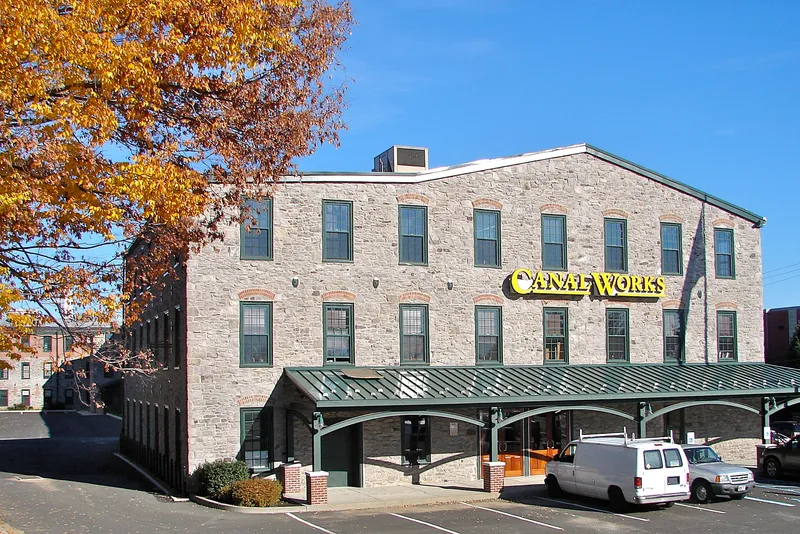
Bristol's northern edge holds a cluster of nineteenth-century mills that formed the core of the borough's manufacturing economy. The Bristol Improvement Company, a group of local businessmen led in part by Joshua Peirce, built five large mill complexes between 1876 and 1885 to attract manufacturers, and exempted the mills from borough taxation for their first ten years. The walls are largely Delaware River sandstone with red brick used for cornices and window arches. The Grundy Mill Complex includes a seven-story spinning mill and warehouse and a 168-foot clock tower, erected around 1910, which are among the first reinforced concrete industrial buildings in Bucks County. Joseph R. Grundy, later a U.S. Senator, owned the Grundy Mills, which became the largest employer in the county by 1919. The Bristol Carpet Mills produced Wilton rugs. The district is listed for its industrial history and for its architecture.
Significance in brief: The district is significant for its association with the Bristol Improvement Company, whose mill-building program helped turn Bristol into Bucks County's principal manufacturing center. It is architecturally significant as a collection of stone and brick mills showing the evolution of industrial architecture, including early reinforced concrete buildings from about 1910 to 1915.
Machine-generated summary. This summary was generated by a language model from the official nomination document and has not been reviewed line by line by an editor. It may contain errors. Check the source document before relying on any detail. Source: nomination document (PDF) · National Archives catalog entry. NRHP reference 87002016, listed November 16, 1987. Summary generated October 2026 (model claude-haiku-5-5, prompt v1.1-2026-10-29, confidence high).
Key facts
| Address | Roughly bounded by Pennsylvania Canal, Jefferson Ave., Canal St., Pennsylvania RR, & Beaver St., Bristol |
|---|---|
| County | Bucks County |
| Listed | November 16, 1987 |
| Reference number | 87002016 |
| Resource type | District |
| Period of significance | 1868-1937 |
| Architect / builder | Bristol Improvement Company; Heacock and Hokanson (architects of the reinforced concrete buildings) |
| Criteria |
|
| Areas of significance | Industry, Architecture |
| Level of significance | Local |
| Status (as stated in the nomination) | Most contributing complexes remain in industrial use; the Bristol Carpet Mills are vacant. |
| Acreage | 13.8 |
| Coordinates | 40.10249, -74.85338 (NPS GIS) |
What listing means for this property
This is a historic district. Buildings within its boundary are either contributing (they add to the district's significance) or non-contributing. Owners of contributing income-producing buildings can claim the 20% federal rehabilitation tax credit; homeowners should look at state credits. National Register districts impose no design review by themselves; a local historic district ordinance, if one exists, does (the difference explained).
General information, not legal or tax advice. Rules change; confirm with your State Historic Preservation Office or a qualified adviser.
Sources and further reading
- National Park Service, National Register of Historic Places database (snapshot May 2026), reference 87002016.
- Nomination form (PDF, National Archives) — catalog entry
- Wikipedia article (used for cross-checking only; text not reproduced here)
- Wikidata Q4968935
- This listing as JSON
Last updated October 2026. Found an error? See the editorial policy for how to report it.