Hollidaysburg Historic District
Also known as: See Also:Blair County Courthouse; Highland Hall

Why it's listed
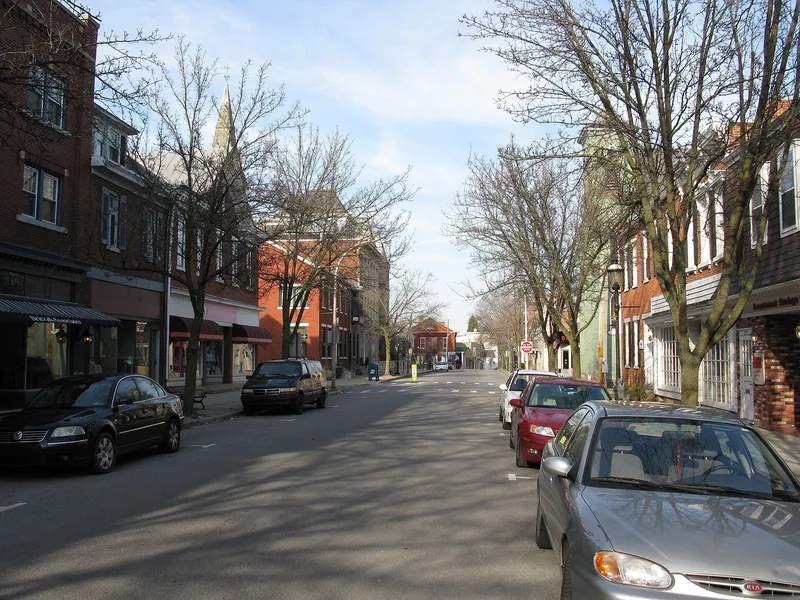
Hollidaysburg's historic district covers the older core of a county seat set on hilly ground above the Beaverdam Branch of the Juniata River, laid out on a grid in 1796 around a central square called the Diamond. It contains 457 buildings, and the nomination stresses their integrity and their number. Canal and railroad trade after 1832 brought warehouses, hotels and banks, and the county seat drew lawyers who later became judges and legislators. The district's architecture ranges from brick Federal houses and Greek Revival dwellings to Italianate, Second Empire, Romanesque Revival, Queen Anne and early twentieth-century Colonial Revival buildings. Notable works include the 1877 Gothic Revival courthouse, the 1869-70 Presbyterian Church and the 1902 Citizen's National Bank. Many Allegheny Street commercial buildings survive largely intact, giving a clear view of nineteenth-century business construction in the town.
Significance in brief: The nomination argues that the district holds a large, well-preserved collection of pre-Civil War residential and commercial buildings and a broad range of Victorian houses and public buildings. It ties the town's development to its role as the transfer point between the Pennsylvania Canal and the Allegheny Portage Railroad, and to its position as county seat attracting prominent lawyers and jurists.
Machine-generated summary. This summary was generated by a language model from the official nomination document and has not been reviewed line by line by an editor. It may contain errors. Check the source document before relying on any detail. Source: nomination document (PDF) · National Archives catalog entry. NRHP reference 85003158, listed December 26, 1985. Summary generated October 2026 (model claude-haiku-5-5, prompt v1.1-2026-10-29, confidence medium).
Key facts
| Address | Roughly bounded by Spruce, Bella, Blair, and Juniata Sts., Hollidaysburg |
|---|---|
| County | Blair County |
| Listed | December 26, 1985 |
| Reference number | 85003158 |
| Resource type | District |
| Period of significance | 1830-1925 |
| Architectural style | Federal, Greek Revival, Gothic Revival, Italianate, Second Empire, Victorian Gothic, Romanesque Revival, Queen Anne, Colonial Revival, Neo-Classical |
| Areas of significance | Industry, Commerce, Transportation, Politics/Government, Architecture |
| Level of significance | Local |
| Acreage | 102.3 |
| Coordinates | 40.43064, -78.39088 (NPS GIS) |
What listing means for this property
This is a historic district. Buildings within its boundary are either contributing (they add to the district's significance) or non-contributing. Owners of contributing income-producing buildings can claim the 20% federal rehabilitation tax credit; homeowners should look at state credits. National Register districts impose no design review by themselves; a local historic district ordinance, if one exists, does (the difference explained).
General information, not legal or tax advice. Rules change; confirm with your State Historic Preservation Office or a qualified adviser.
Sources and further reading
- National Park Service, National Register of Historic Places database (snapshot May 2026), reference 85003158.
- Nomination form (PDF, National Archives) — catalog entry
- Wikipedia article (used for cross-checking only; text not reproduced here)
- Wikidata Q15224539
- This listing as JSON
Last updated October 2026. Found an error? See the editorial policy for how to report it.