Main-Market Historic District

Why it's listed
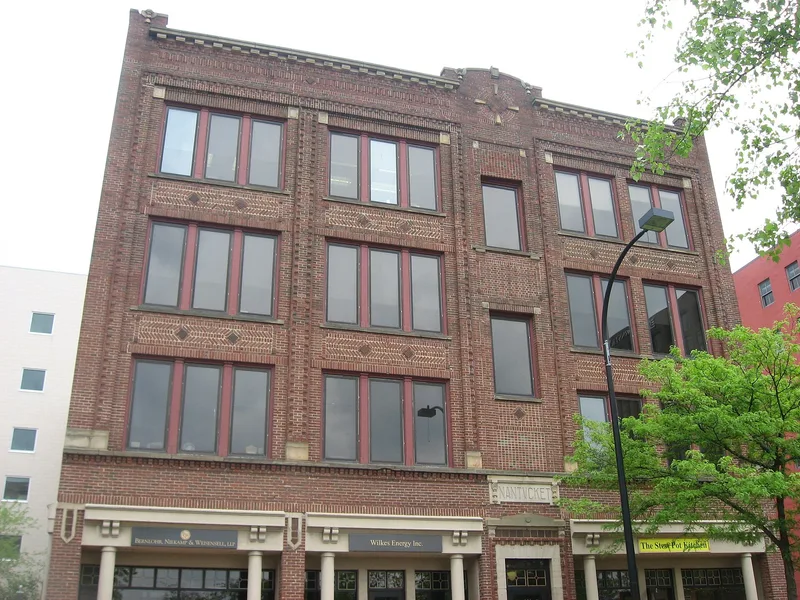
Main-Market Historic District occupies about 30 acres of downtown Akron, Ohio, around North and South Main Street and East Market Street. It follows the street grid laid out in 1833 as the North Village, also called Cascade Village after a mill race built in 1831 to power industry. Seventeen contributing buildings survive, ranging from a Greek Revival masonry commercial building to Beaux Arts, Chicago Commercial, Neo-Classical Revival and Art Deco structures. Among them are the Northern Ohio Traction & Light interurban terminal, completed in 1918 and enlarged by two stories in 1931, and its 1912 brick substation. Also notable are the East Ohio Gas building and the Akron Post Office and Federal Building. Together they show how the area moved from canal-era commerce to railroads, interurban lines, utilities and the rubber boom, when the city's population rose 200 percent between 1910 and 1920. The period of significance runs from 1863 to 1950, and the district was recognized for its contributions to commerce, communications, transportation, education and architecture.
Significance in brief: The district records Akron's growth from a canal town into a railroad, interurban and rubber-industry city. It was a center of commerce, communications, transportation and education. It also holds a concentration of academic-style commercial and civic buildings, including the interurban terminal, a substation, a gas company building and a post office.
Machine-generated summary. This summary was generated by a language model from the official nomination document and has not been reviewed line by line by an editor. It may contain errors. Check the source document before relying on any detail. Source: nomination document (PDF) · National Archives catalog entry. NRHP reference 03000719, listed August 1, 2003. Summary generated October 2026 (model claude-sonnet-5-5, prompt v1.0-2026-10-29, confidence medium).
Key facts
| Address | 15-47 N. Main St., 1-39 S. Main St., 39-168 E. Market St., 18-42 N. High St., 70 Broadway St., Akron |
|---|---|
| County | Summit County |
| Listed | August 1, 2003 |
| Reference number | 03000719 |
| Resource type | District |
| Period of significance | 1863-1950 |
| Architect / builder | Harpster & Bliss, Frank O. Weary, Jacob Snyder, Heard & Blythe (Cleveland), James Knox Taylor, Sommerfield & Streckler (NY), James A. Wetmore, Allied Engineers, Inc., Allen & De Young (NY), C.L. Briggs, Rollin, Mulchay & Carmichael, Dwight P. Robinson, Algernon Blair, H.P. Moran Construction Co., John Crisp, Clemmer-Johnson Construction Co., McClintock-Marchal Co. |
| Architectural style | Greek Revival, Second Empire, Eastlake/Queen Anne, Italian Renaissance Revival, Second Renaissance Revival, Beaux Arts, Chicago/Commercial Style, Neo-Classical Revival, Art Deco |
| Criteria |
|
| Areas of significance | Commerce, Communications, Transportation, Education, Architecture |
| Level of significance | Local |
| Status (as stated in the nomination) | Buildings are in mixed use, including offices, government use and storage; some resources are listed as vacant or not in use. |
| Acreage | 30 |
| Coordinates | 41.08662, -81.51384 (NPS GIS) |
What listing means for this property
This is a historic district. Buildings within its boundary are either contributing (they add to the district's significance) or non-contributing. Owners of contributing income-producing buildings can claim the 20% federal rehabilitation tax credit; homeowners should look at state credits. National Register districts impose no design review by themselves; a local historic district ordinance, if one exists, does (the difference explained).
General information, not legal or tax advice. Rules change; confirm with your State Historic Preservation Office or a qualified adviser.
Sources and further reading
- National Park Service, National Register of Historic Places database (snapshot May 2026), reference 03000719.
- Nomination form (PDF, National Archives) — catalog entry
- Wikipedia article (used for cross-checking only; text not reproduced here)
- Wikidata Q6735883
- This listing as JSON
Last updated October 2026. Found an error? See the editorial policy for how to report it.