Jackson, Andrew, House
Also known as: Odd Fellows Temple

Why it's listed
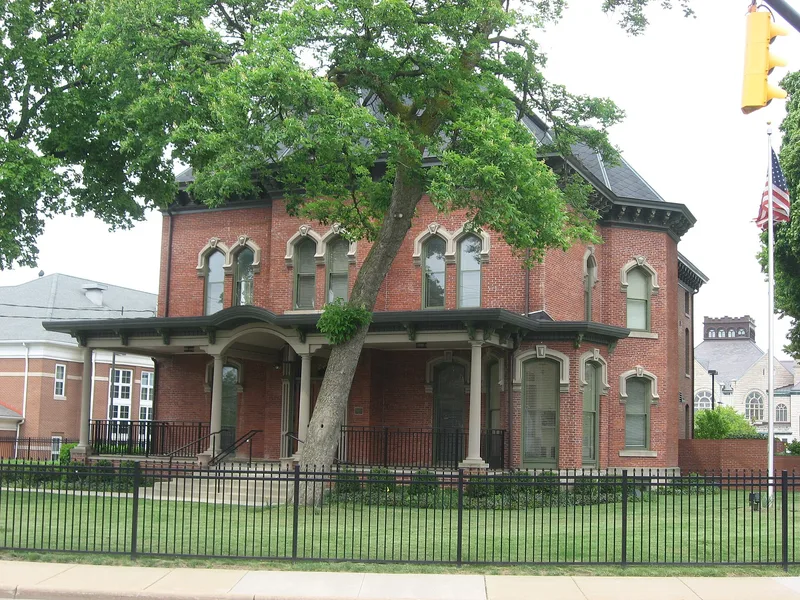
Built around 1870 on East Mill Street in Akron, this large brick mansion in the Second Empire style began as the home of Andrew Jackson, a lumber merchant. He helped found Jackson, Buchtel and Company in 1865, a firm that developed large logging tracts in Michigan, and he later worked as a contractor and builder. The house is symmetrical, with a steep mansard roof on a densely bracketed cornice, a slightly projecting center bay and polygonal side bays. Around 1900 it belonged to John T. Johnson, a railroad superintendent. In 1918 the Akron Odd Fellows lodge, organized in 1845, bought it and moved in the next year. They added porches and created a large second-floor meeting hall, while much of the original first-floor woodwork survives. It faces a small triangular park and serves as a local focal point. At the time of listing it faced possible demolition for a parking lot.
Significance in brief: The nomination presents it as a handsome Second Empire house converted to a fraternal lodge. It was built by Andrew Jackson, a founder of a major lumber firm and later a contractor and builder, who was associated with leading industrial figures of Akron. The Akron I.O.O.F. bought it in 1918, and its membership included prominent city officials and professionals.
Machine-generated summary. This summary was generated by a language model from the official nomination document and has not been reviewed line by line by an editor. It may contain errors. Check the source document before relying on any detail. Source: nomination document (PDF) · National Archives catalog entry. NRHP reference 75001537, listed February 13, 1975. Summary generated October 2026 (model claude-sonnet-5-5, prompt v1.0-2026-10-29, confidence medium).
Key facts
| Address | 277 E. Mill St., Akron |
|---|---|
| County | Summit County |
| Listed | February 13, 1975 |
| Reference number | 75001537 |
| Resource type | Building |
| Architectural style | Second Empire |
| Areas of significance | Commerce, Architecture, Social History |
| Level of significance | Local |
| Status (as stated in the nomination) | Described as in good condition and altered, with preservation work in progress; still used as a meeting place for fraternal organizations. At the time of nomination it was threatened with acquisition and demolition for a parking lot. |
| Acreage | 0.9 |
| Coordinates | 41.08014, -81.50911 (NPS GIS) |
What listing means for this property
National Register listing is honorary for a privately owned home: it does not by itself restrict what an owner may do with their own money, and it does not require public access. Restrictions come from local landmark or historic-district ordinances, which are separate (how they differ).
Owner-occupied houses are not eligible for the 20% federal rehabilitation tax credit, which applies to income-producing buildings, but many states offer credits for homeowners. Listing also opens the door to preservation easements and to buying a plaque. Start with what listing means for homeowners, renovating a listed house and selling one.
General information, not legal or tax advice. Rules change; confirm with your State Historic Preservation Office or a qualified adviser.
Sources and further reading
- National Park Service, National Register of Historic Places database (snapshot May 2026), reference 75001537.
- Nomination form (PDF, National Archives) — catalog entry
- Wikidata Q138690529
- This listing as JSON
Last updated October 2026. Found an error? See the editorial policy for how to report it.