Fulton Farm
Also known as: River Bend Farm; Amann Residence

Why it's listed
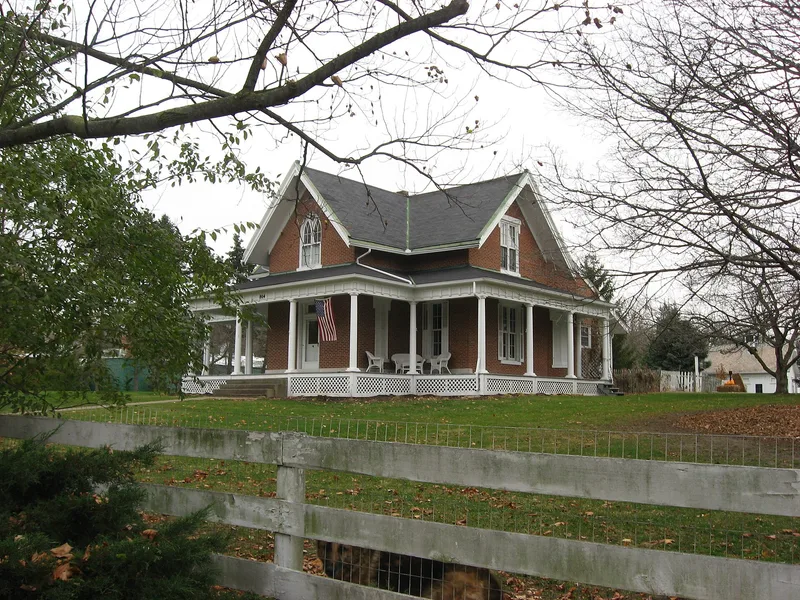
Built about 1848-1850 for Isaac T. Fulton and his bride, this Early Gothic Revival farmhouse in Sidney, Ohio, sits on a small farmstead beside the Great Miami River. Fulton made the bricks for the house and outbuildings himself. The 1½-story house has limestone lintels and labels, Gothic traceried gable windows, and an interior with distinctive walnut woodwork and a spiral staircase. In 1894 John Loughlin, a school desk manufacturer, bought the property, added a neo-classical porch and a northeast addition, and had a carriage house completed in 1898. In 1896 he began the Mary L. Poultry Plant next to the house, a highly mechanized operation said to be the largest and most modern of its kind, which drew railroad excursions. The plant failed and was demolished in the 1940s. The house, carriage house, smokehouse, chicken house and barn remain. The site is notable for its agricultural and poultry history and for a Gothic Revival style rare in western Ohio.
Significance in brief: The nomination argues the farm is significant for its link to agriculture and the poultry industry. The Fulton house is described as one of the most ornate pre-Civil War farmhouses in Shelby County. Around 1900 the Mary L. Poultry Plant on the grounds drew national attention. The Gothic Revival style was also uncommon in western Ohio.
Machine-generated summary. This summary was generated by a language model from the official nomination document and has not been reviewed line by line by an editor. It may contain errors. Check the source document before relying on any detail. Source: nomination document (PDF) · National Archives catalog entry. NRHP reference 79001947, listed May 8, 1979. Summary generated October 2026 (model claude-sonnet-5-5, prompt v1.0-2026-10-29, confidence high).
Key facts
| Address | 804 S. Brooklyn Ave., Sidney |
|---|---|
| County | Shelby County |
| Listed | May 8, 1979 |
| Reference number | 79001947 |
| Resource type | Building |
| Period of significance | 1800-1899 |
| Architect / builder | Isaac T. Fulton |
| Architectural style | Early Gothic Revival |
| Areas of significance | Architecture, Agriculture |
| Level of significance | Local |
| Status (as stated in the nomination) | Described as in excellent condition, occupied as a private residence, and repaired and well maintained by its owners. |
| Acreage | 2 |
| Coordinates | 40.27630, -84.14859 (NPS GIS) |
What listing means for this property
National Register listing is honorary for a privately owned home: it does not by itself restrict what an owner may do with their own money, and it does not require public access. Restrictions come from local landmark or historic-district ordinances, which are separate (how they differ).
Owner-occupied houses are not eligible for the 20% federal rehabilitation tax credit, which applies to income-producing buildings, but many states offer credits for homeowners. Listing also opens the door to preservation easements and to buying a plaque. Start with what listing means for homeowners, renovating a listed house and selling one.
General information, not legal or tax advice. Rules change; confirm with your State Historic Preservation Office or a qualified adviser.
Sources and further reading
- National Park Service, National Register of Historic Places database (snapshot May 2026), reference 79001947.
- Nomination form (PDF, National Archives) — catalog entry
- Wikipedia article (used for cross-checking only; text not reproduced here)
- Wikidata Q5508426
- This listing as JSON
Last updated October 2026. Found an error? See the editorial policy for how to report it.