Macomb, Mary Worthington, House
Also known as: Old Stone House

Why it's listed
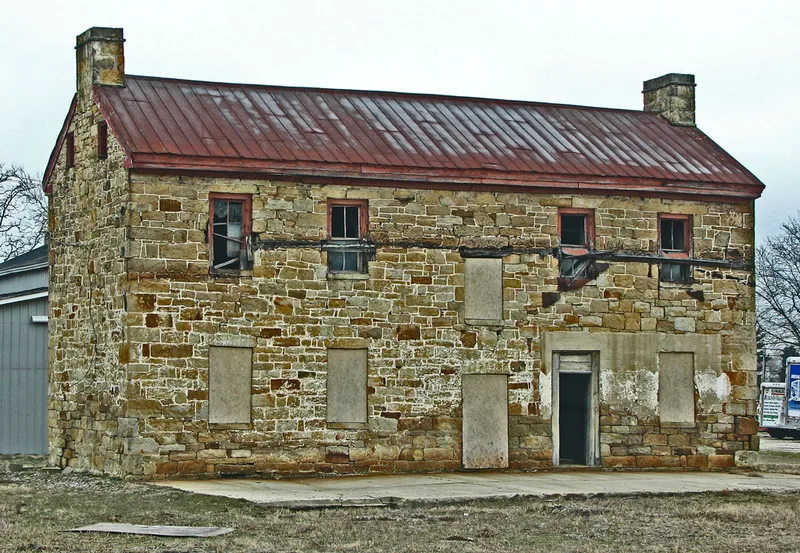
Built of broken-course cut sandstone, this two-story house on South Paint Street in Chillicothe sits beside Paint Creek and is known locally as the Old Stone House. It measures 20 by 49 feet, with a central entrance hall, equal-sized rooms on each side, radiating stone lintels with keystones, and pre-Victorian mantels and cabinetry inside. Its exact construction date is uncertain, but deed prices point to the period between 1811 and 1815. Governor Thomas Worthington bought it in 1815, and his daughter Mary and her husband David Macomb lived there while managing his nearby cloth mill, which was part of a trading network reaching from the East Coast to the Southwest. Later owners were pork packers, a major local industry. The house resembles Ohio's first capitol and Worthington's home, Adena, and its architectural character remains largely intact. Today it stands in a lumber yard, with only a metal lean-to shed added.
Significance in brief: The nomination argues the house is tied to early settlers of Ohio and the Old Northwest Territory. It is also linked to the early growth of industry and commerce through Governor Thomas Worthington's mill enterprises. It is a rare surviving example of the architecture of Chillicothe's earliest important buildings, and resembles the first Ohio capitol and Adena.
Machine-generated summary. This summary was generated by a language model from the official nomination document and has not been reviewed line by line by an editor. It may contain errors. Check the source document before relying on any detail. Source: nomination document (PDF) · National Archives catalog entry. NRHP reference 76001525, listed April 26, 1976. Summary generated October 2026 (model claude-sonnet-5-5, prompt v1.0-2026-10-29, confidence medium).
Key facts
| Address | 490 S. Paint St., Chillicothe |
|---|---|
| County | Ross County |
| Listed | April 26, 1976 |
| Reference number | 76001525 |
| Resource type | Building |
| Period of significance | 1800-1899 |
| Areas of significance | Commerce, Exploration/Settlement, Architecture |
| Level of significance | Local |
| Status (as stated in the nomination) | Listed as unoccupied and in fair condition, altered only by a one-story metal lean-to shed; it now stands on a 5.31-acre parcel in a lumber yard. |
| Acreage | 1 |
| Coordinates | 39.32196, -82.98004 (NPS GIS) |
What listing means for this property
National Register listing is honorary for a privately owned home: it does not by itself restrict what an owner may do with their own money, and it does not require public access. Restrictions come from local landmark or historic-district ordinances, which are separate (how they differ).
Owner-occupied houses are not eligible for the 20% federal rehabilitation tax credit, which applies to income-producing buildings, but many states offer credits for homeowners. Listing also opens the door to preservation easements and to buying a plaque. Start with what listing means for homeowners, renovating a listed house and selling one.
General information, not legal or tax advice. Rules change; confirm with your State Historic Preservation Office or a qualified adviser.
Sources and further reading
- National Park Service, National Register of Historic Places database (snapshot May 2026), reference 76001525.
- Nomination form (PDF, National Archives) — catalog entry
- Wikipedia article (used for cross-checking only; text not reproduced here)
- Wikidata Q6780989
- This listing as JSON
Last updated October 2026. Found an error? See the editorial policy for how to report it.