Kemp, Lewis, House

Approximate location: the National Park Service places this pin arbitrarily within the property, not at a surveyed point (stated accuracy ±12 m).
Why it's listed
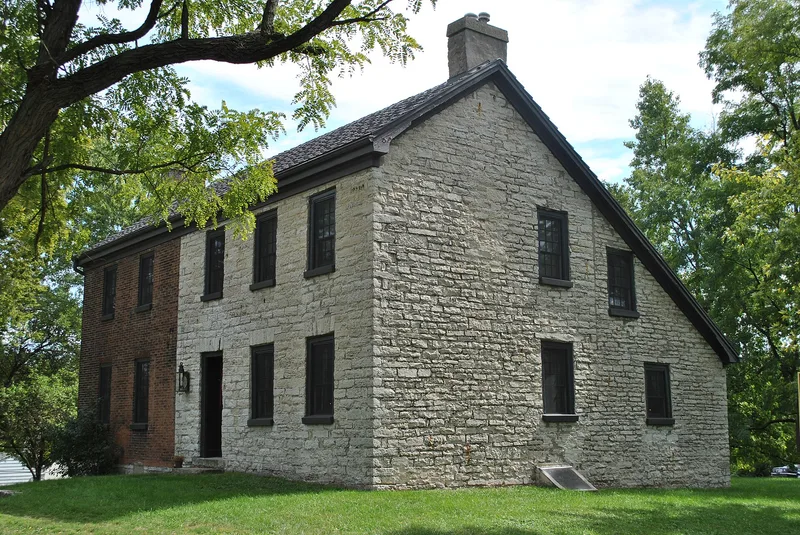
Built around 1806, this two-story saltbox on Burkhardt Avenue in Dayton began as a three-bay rough-cut limestone house with a coursed stone foundation. A two-bay brick addition later extended it while keeping the saltbox form, and a small gable-roofed front porch was added around 1900. Lewis Kemp and his wife Elizabeth, with eight children, came from Frederick County, Maryland, with a party of 96 people and settled in Mad River Township, where he built the house soon after arriving. Kemp also donated about an acre in 1815 for the township's oldest burial ground, and a log schoolhouse was built nearby the same year. The house is regarded as the oldest private residence in Dayton. When nominated, it was vandalized inside but structurally sound, and a public housing project was being built behind it. Its location on a hazardous curve raised the possibility of demolition for road straightening.
Significance in brief: The nomination argues it is the oldest private residence in the city of Dayton. It is tied to Lewis Kemp, an early Mad River Township settler who also donated land for the township's oldest burial ground. It is also a surviving example of a vernacular saltbox with an early brick addition.
Machine-generated summary. This summary was generated by a language model from the official nomination document and has not been reviewed line by line by an editor. It may contain errors. Check the source document before relying on any detail. Source: nomination document (PDF) · National Archives catalog entry. NRHP reference 75001502, listed January 23, 1975. Summary generated October 2026 (model claude-sonnet-5-5, prompt v1.0-2026-10-29, confidence high).
Key facts
| Address | 4800 Burkhardt Ave., Dayton |
|---|---|
| County | Montgomery County |
| Listed | January 23, 1975 |
| Reference number | 75001502 |
| Resource type | Building |
| Period of significance | 19th Century (specific date c. 1806 for the stone portion) |
| Architectural style | Vernacular Saltbox |
| Areas of significance | Architecture, Social History |
| Level of significance | Local |
| Status (as stated in the nomination) | Described as deteriorated and vandalized, with doors, hardware and one mantel removed and wiring exposed, but structurally sound with excellent potential for restoration. A public housing development is under construction behind it, and the data sheet lists it as vacant. |
| Acreage | 0.9 |
| Coordinates | 39.75815, -84.12585 (NPS GIS) |
What listing means for this property
National Register listing is honorary for a privately owned home: it does not by itself restrict what an owner may do with their own money, and it does not require public access. Restrictions come from local landmark or historic-district ordinances, which are separate (how they differ).
Owner-occupied houses are not eligible for the 20% federal rehabilitation tax credit, which applies to income-producing buildings, but many states offer credits for homeowners. Listing also opens the door to preservation easements and to buying a plaque. Start with what listing means for homeowners, renovating a listed house and selling one.
Noted as vacant in the nomination. Nomination documents can be decades old; current status may differ. If you are considering buying an empty listed property, read the due-diligence checklist.
General information, not legal or tax advice. Rules change; confirm with your State Historic Preservation Office or a qualified adviser.
Sources and further reading
- National Park Service, National Register of Historic Places database (snapshot May 2026), reference 75001502.
- Nomination form (PDF, National Archives) — catalog entry
- Wikipedia article (used for cross-checking only; text not reproduced here)
- Wikidata Q6536762
- This listing as JSON
Last updated October 2026. Found an error? See the editorial policy for how to report it.