Blake, H. G., House
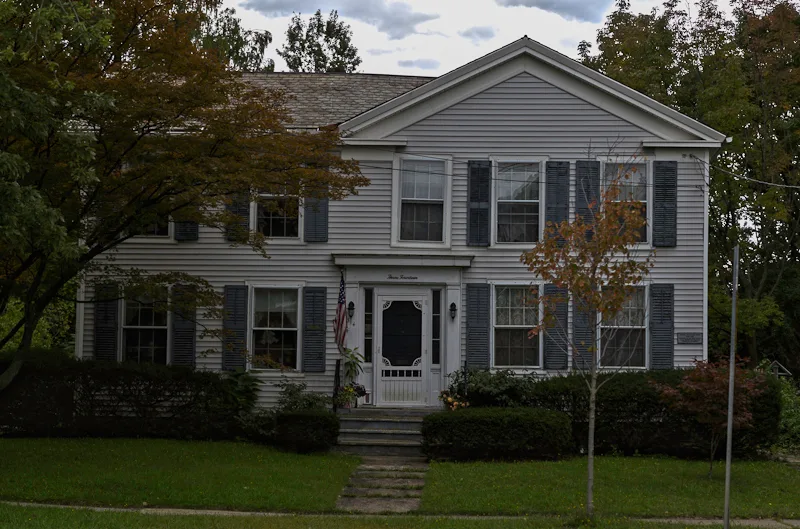

Why it's listed
Located at 314 East Washington Street in Medina, this Greek Revival house was apparently built in 1848 and grew in three stages. The original west wing has a gabled end with a wide cornice and returns, and a doorway with side lights and an entablature. An east wing, possibly added after 1851, has narrower trim and a hipped gable. In 1873 Oliver C. Shepard added an extension that gave the house an L-shaped plan. The roof is slate, and the grounds include a barn foundation and a grape arbor. The house matters for its architecture, since the additions respected the original style, and for its residents. H. G. Blake, founder of the Old Phoenix National Bank and a United States Congressman, lived there from 1856 to 1861, when, according to his daughter, it served as an underground railroad station. From 1873 onward the house passed through the Shepard family and its descendants, who took part in Medina's commercial and social life.
Significance in brief: The nomination argues the house shows how additions were made over time without altering its original Greek Revival character, and it remains a local landmark. It is also tied to residents who were active in Medina's commercial and social life, and it served as an underground railroad station before the Civil War.
Machine-generated summary. This summary was generated by a language model from the official nomination document and has not been reviewed line by line by an editor. It may contain errors. Check the source document before relying on any detail. Source: nomination document (PDF) · National Archives catalog entry. NRHP reference 82003612, listed September 30, 1982. Summary generated October 2026 (model claude-sonnet-5-5, prompt v1.0-2026-10-29, confidence high).
Key facts
| Address | 314 E. Washington St., Medina |
|---|---|
| County | Medina County |
| Listed | September 30, 1982 |
| Reference number | 82003612 |
| Resource type | Building |
| Period of significance | 1800-1899 (specific dates 1848; 1856-1861; 1896) |
| Architect / builder | Unknown; records indicate William W. Boardman constructed the original portion, though no reliable information about him exists |
| Architectural style | Greek Revival |
| Areas of significance | Architecture, Social History |
| Level of significance | Local |
| Status (as stated in the nomination) | Occupied as a private residence; condition listed as excellent and altered. |
| Acreage | 1.2 |
| Coordinates | 41.13786, -81.86023 (NPS GIS) |
What listing means for this property
National Register listing is honorary for a privately owned home: it does not by itself restrict what an owner may do with their own money, and it does not require public access. Restrictions come from local landmark or historic-district ordinances, which are separate (how they differ).
Owner-occupied houses are not eligible for the 20% federal rehabilitation tax credit, which applies to income-producing buildings, but many states offer credits for homeowners. Listing also opens the door to preservation easements and to buying a plaque. Start with what listing means for homeowners, renovating a listed house and selling one.
General information, not legal or tax advice. Rules change; confirm with your State Historic Preservation Office or a qualified adviser.
Sources and further reading
- National Park Service, National Register of Historic Places database (snapshot May 2026), reference 82003612.
- Nomination form (PDF, National Archives) — catalog entry
- Wikidata Q138570074
- This listing as JSON
Last updated October 2026. Found an error? See the editorial policy for how to report it.