Wright, Dr. John A., House
Also known as: Harvey House

Why it's listed
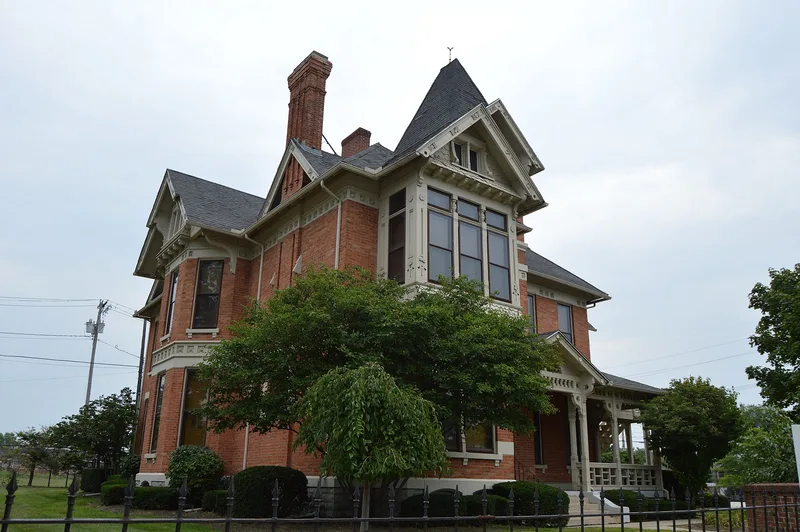
Occupying most of a city block along Cherry Street, a main route into downtown Toledo, this Queen Anne house was built in 1888-89 and later became the home of Dr. John A. Wright. It is a 2½-story painted red brick building with stone and wood trim, five molded chimneys, a multi-gabled roof and a tower topped by a pyramidal steeple with iron cresting. Carved stone lintels, stained glass and extensive incised woodwork on gables and porches decorate it, and an L-shaped brick carriage barn stands beside it. The nomination praises it as one of the finest Queen Anne works in Northwest Ohio. Wright, who began practice in Toledo in 1877, used the city's first Roentgen x-ray machine from 1909 in an office built next to the house, since demolished. He also wrote for medical journals and built apartments, including the Majestic. Burns from his x-ray work contributed to his death in 1929.
Significance in brief: The nomination calls it one of the finest achievements of the Queen Anne style in Northwest Ohio, remaining virtually unaltered as a Toledo landmark. It was also the home of Dr. John A. Wright, a physician who pioneered the local use of x-rays and used Toledo's first Roentgen x-ray machine from 1909.
Machine-generated summary. This summary was generated by a language model from the official nomination document and has not been reviewed line by line by an editor. It may contain errors. Check the source document before relying on any detail. Source: nomination document (PDF) · National Archives catalog entry. NRHP reference 78002129, listed October 5, 1978. Summary generated October 2026 (model claude-sonnet-5-5, prompt v1.0-2026-10-29, confidence high).
Key facts
| Address | 1822 Cherry St., Toledo |
|---|---|
| County | Lucas County |
| Listed | October 5, 1978 |
| Reference number | 78002129 |
| Resource type | Building |
| Period of significance | 1800-1899 |
| Architectural style | Queen Anne |
| Areas of significance | Science, Architecture, Social History |
| Level of significance | Local |
| Status (as stated in the nomination) | The form lists the property as occupied and private. It notes the house is virtually unaltered, while the carriage barn lost its cupola and a roof section and the doctor's office was demolished. The future of the property was described as in serious doubt after the 1977 death of the last family occupant. |
| Acreage | 0.9 |
| Coordinates | 41.66572, -83.53923 (NPS GIS) |
What listing means for this property
National Register listing is honorary for a privately owned home: it does not by itself restrict what an owner may do with their own money, and it does not require public access. Restrictions come from local landmark or historic-district ordinances, which are separate (how they differ).
Owner-occupied houses are not eligible for the 20% federal rehabilitation tax credit, which applies to income-producing buildings, but many states offer credits for homeowners. Listing also opens the door to preservation easements and to buying a plaque. Start with what listing means for homeowners, renovating a listed house and selling one.
General information, not legal or tax advice. Rules change; confirm with your State Historic Preservation Office or a qualified adviser.
Sources and further reading
- National Park Service, National Register of Historic Places database (snapshot May 2026), reference 78002129.
- Nomination form (PDF, National Archives) — catalog entry
- Wikidata Q138542549
- This listing as JSON
Last updated October 2026. Found an error? See the editorial policy for how to report it.