Moore, Edward W. and Louise C., Estate
Also known as: Mooreland

Why it's listed
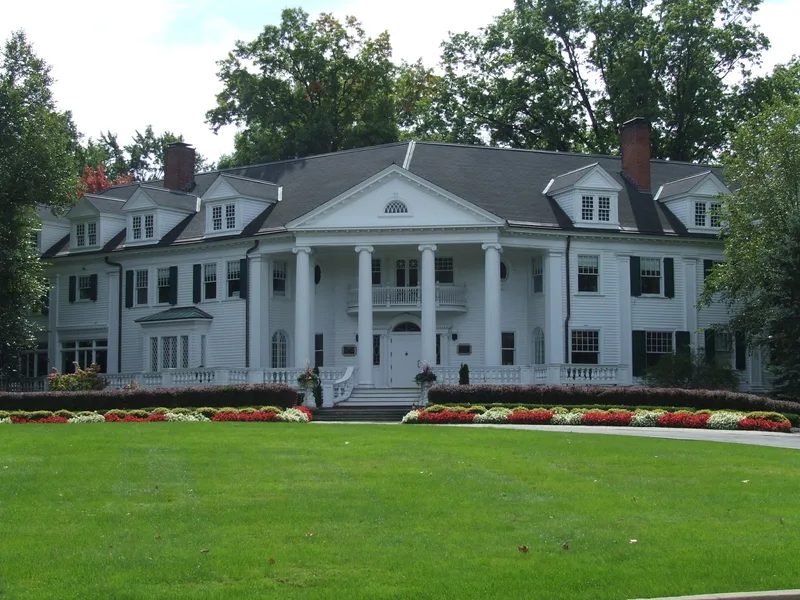
Mooreland is a large, wood-frame Neo-Classical summer estate house in Mentor, Ohio, built between 1897 and 1900 for Cleveland financier Edward W. Moore. Its unusual V-shaped plan is dominated by a two-story portico with four fluted Ionic columns. In 1906-07 architect J. Milton Dyer extended the wings and enlarged the kitchen and upper floors, while keeping the original classical character. The surviving grounds include a gazebo, teahouse, hennery, greenhouse, pools, pergolas and formal gardens, with a landscape plan by Cleveland designer A. Donald Gray. Moore, with partner Henry Everett, promoted and built electric railway and interurban lines that helped Cleveland's suburbs grow. The estate also illustrates how wealthy Clevelanders made Lake County a summer retreat. It once covered more than 1,000 acres. Interstate construction in the 1960s cut it in half, and the remainder passed to Lakeland Community College in 1968. The house has stood empty since 1982, though it retains its original character and much early fabric.
Significance in brief: The estate is tied to Edward W. Moore, a Cleveland capitalist who helped build electric railway and interurban lines that spurred suburban growth. It is an intact example of the grand summer residences that made Lake County a summer community for wealthy Clevelanders. It is also an excellent Neo-Classical design by architects Arthur N. Oviatt and J. Milton Dyer, with landscaping by A. Donald Gray.
Machine-generated summary. This summary was generated by a language model from the official nomination document and has not been reviewed line by line by an editor. It may contain errors. Check the source document before relying on any detail. Source: nomination document (PDF) · National Archives catalog entry. NRHP reference 88000209, listed March 10, 1988. Summary generated October 2026 (model claude-sonnet-5-5, prompt v1.0-2026-10-29, confidence medium).
Key facts
| Address | 7960 Garfield Rd., Mentor |
|---|---|
| County | Lake County |
| Listed | March 10, 1988 |
| Reference number | 88000209 |
| Resource type | Building |
| Period of significance | 1897-1928 |
| Architect / builder | Arthur N. Oviatt (1897-1900 house); J. Milton Dyer (1906-07 enlargement); A. Donald Gray, landscape architect |
| Architectural style | Classical Revival (Neo-Classical) |
| Criteria |
|
| Areas of significance | Community Planning and Development, Transportation, Architecture |
| Level of significance | State |
| Status (as stated in the nomination) | The house has been deserted, though protected by the college, since 1982; it is somewhat deteriorated but retains a high degree of integrity. |
| Acreage | 25 |
| Coordinates | 41.63887, -81.35652 (NPS GIS) |
What listing means for this property
National Register listing is honorary for a privately owned home: it does not by itself restrict what an owner may do with their own money, and it does not require public access. Restrictions come from local landmark or historic-district ordinances, which are separate (how they differ).
Owner-occupied houses are not eligible for the 20% federal rehabilitation tax credit, which applies to income-producing buildings, but many states offer credits for homeowners. Listing also opens the door to preservation easements and to buying a plaque. Start with what listing means for homeowners, renovating a listed house and selling one.
Noted as vacant in the nomination. Nomination documents can be decades old; current status may differ. If you are considering buying an empty listed property, read the due-diligence checklist.
General information, not legal or tax advice. Rules change; confirm with your State Historic Preservation Office or a qualified adviser.
Sources and further reading
- National Park Service, National Register of Historic Places database (snapshot May 2026), reference 88000209.
- Nomination form (PDF, National Archives) — catalog entry
- Wikidata Q138448409
- This listing as JSON
Last updated October 2026. Found an error? See the editorial policy for how to report it.