Jones, Elijah Pelton, House
Also known as: Lynn Mawr Inn

Why it's listed
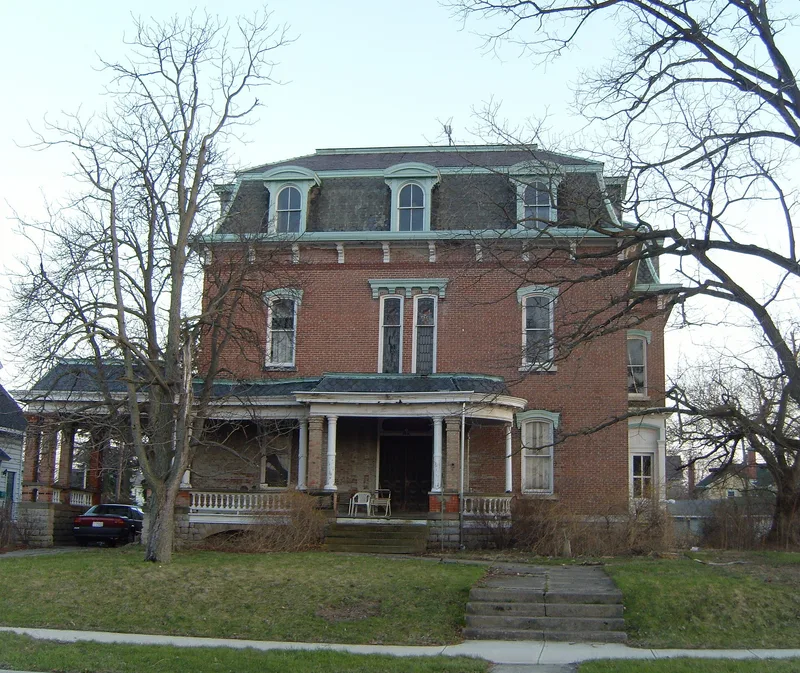
Built around 1863, this three-story brick house at 313 East Sandusky Street in Findlay, Ohio, is a prominent example of Second Empire design. It has a mansard roof with fish scale tiles, elliptically arched dormers with carved lintels, scroll-like cornice brackets, corbelled brick chimneys and a porch added about 1890. A rear carriage house with carved wooden eaves resembles a train depot. Inside are etched wallpaper, carved mantels, parquet floors, a circular wood staircase and a dining room ceiling with massive carved beams. The house was built for Elijah Pelton Jones (1820-1894), who founded the First National Bank of Findlay in 1863 and served as its first president. He also owned real estate and financed oil wells during the gas and oil boom. The house is considered one of the finest Second Empire buildings in the city and keeps more of its original features than five similar buildings. After Jones died, it became a rooming house, the Lynn Mawr Inn, in 1921.
Significance in brief: The nomination argues the house is one of the finest Second Empire buildings in Findlay and retains its nineteenth century features and massive size better than five similar buildings. It is also tied to Elijah Pelton Jones, who founded the First National Bank of Findlay in 1863 and shaped the town's commercial growth during the gas and oil boom.
Machine-generated summary. This summary was generated by a language model from the official nomination document and has not been reviewed line by line by an editor. It may contain errors. Check the source document before relying on any detail. Source: nomination document (PDF) · National Archives catalog entry. NRHP reference 85000563, listed March 14, 1985. Summary generated October 2026 (model claude-sonnet-5-5, prompt v1.0-2026-10-29, confidence high).
Key facts
| Address | 313 East Sandusky St., Findlay |
|---|---|
| County | Hancock County |
| Listed | March 14, 1985 |
| Reference number | 85000563 |
| Resource type | Building |
| Period of significance | 1800-1899 (specific date ca. 1863) |
| Architectural style | Second Empire, with Italianate bracket details |
| Criteria |
|
| Areas of significance | Commerce, Architecture |
| Level of significance | Local |
| Status (as stated in the nomination) | Occupied; used as a rooming house known as the Lynn Mawr Inn from 1921 to the time of the nomination, with condition rated fair and unaltered. |
| Acreage | 0.9 |
| Coordinates | 41.03673, -83.64586 (NPS GIS) |
What listing means for this property
National Register listing is honorary for a privately owned home: it does not by itself restrict what an owner may do with their own money, and it does not require public access. Restrictions come from local landmark or historic-district ordinances, which are separate (how they differ).
Owner-occupied houses are not eligible for the 20% federal rehabilitation tax credit, which applies to income-producing buildings, but many states offer credits for homeowners. Listing also opens the door to preservation easements and to buying a plaque. Start with what listing means for homeowners, renovating a listed house and selling one.
General information, not legal or tax advice. Rules change; confirm with your State Historic Preservation Office or a qualified adviser.
Sources and further reading
- National Park Service, National Register of Historic Places database (snapshot May 2026), reference 85000563.
- Nomination form (PDF, National Archives) — catalog entry
- Wikidata Q138358998
- This listing as JSON
Last updated October 2026. Found an error? See the editorial policy for how to report it.