German Evangelical Protestant Cemetery Chapel
Also known as: Vine Street Hill Cemetery Chapel

Why it's listed
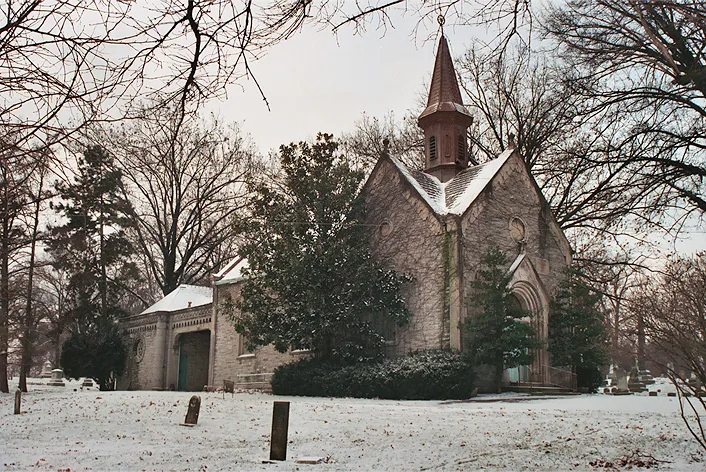
Set near the center of Vine Street Hill Cemetery in Cincinnati, this stone chapel was completed in 1884 and combines Romanesque Revival details such as round arches, zigzag carving and a conical steeple. Behind it stands a receiving vault built in 1850 to hold bodies when frozen ground prevented burial; the new chapel incorporated that vault and linked it with a covered passageway. German inscriptions appear on the dedication plaques and water closet carvings. The chapel was designed by George and August Brink, German-American architect-builders whose clients were almost exclusively German-Americans, and it is the only known religious building they designed. The cemetery was founded in 1849 by members of two German Evangelical churches during a cholera epidemic. The chapel is listed for its architecture, its detailed stonework and stained glass, and its link to Cincinnati's German-American community. Some water damage is noted inside, though overall integrity is high.
Significance in brief: The chapel is nominated under Criterion C as a late nineteenth century eclectic funerary design with Romanesque Revival elements. It represents the work of German-American architect-builders George and August Brink and reflects Cincinnati's large German-American community. It is the only known religious building the Brinks designed.
Machine-generated summary. This summary was generated by a language model from the official nomination document and has not been reviewed line by line by an editor. It may contain errors. Check the source document before relying on any detail. Source: nomination document (PDF) · National Archives catalog entry. NRHP reference 08000115, listed February 28, 2008. Summary generated October 2026 (model claude-sonnet-5-5, prompt v1.0-2026-10-29, confidence high).
Key facts
| Address | 3701 Vine St., Cincinnati |
|---|---|
| County | Hamilton County |
| Listed | February 28, 2008 |
| Reference number | 08000115 |
| Resource type | Building |
| Period of significance | 1850-1884 |
| Architect / builder | Brink, George and August |
| Architectural style | Late Victorian/Romanesque |
| Criteria |
|
| Areas of significance | Architecture |
| Level of significance | Local |
| Status (as stated in the nomination) | Currently used for funerary and religious functions; the interior shows some water damage to flooring and plaster, but the building retains a high degree of integrity. |
| Acreage | 0.9 |
| Coordinates | 39.15601, -84.50882 (NPS GIS) |
What listing means for this property
Religious properties are listed for their architectural or historical significance, not their religious use. Listing is honorary and does not restrict the congregation's use of the building. The federal rehabilitation credit is generally unavailable unless part of the building is income-producing; some state programmes and preservation grants do cover religious buildings. Federal funding or permits trigger Section 106 review.
General information, not legal or tax advice. Rules change; confirm with your State Historic Preservation Office or a qualified adviser.
Sources and further reading
- National Park Service, National Register of Historic Places database (snapshot May 2026), reference 08000115.
- Nomination form (PDF, National Archives) — catalog entry
- Wikipedia article (used for cross-checking only; text not reproduced here)
- Wikidata Q7932389
- This listing as JSON
Last updated October 2026. Found an error? See the editorial policy for how to report it.