Short North Historic District

Why it's listed
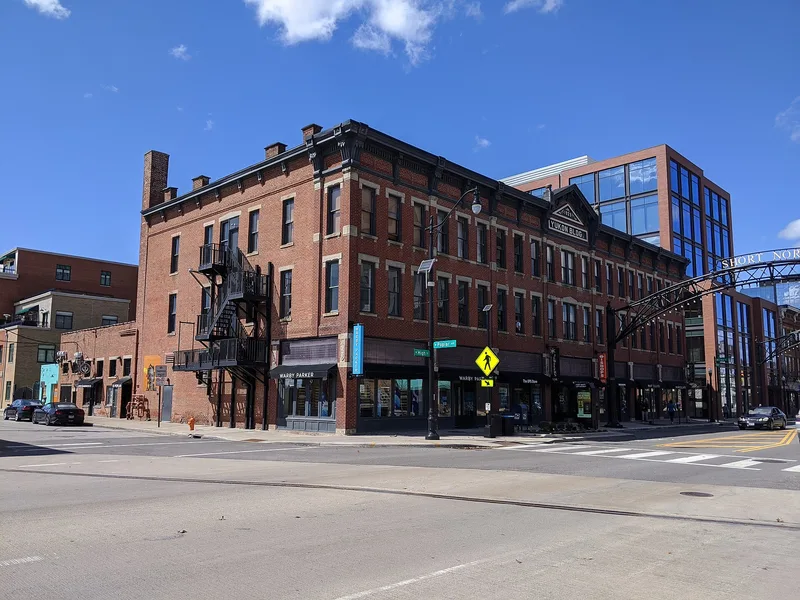
Four blocks of North High Street in Columbus make up this commercial district, where two- and three-story brick buildings with ground-floor storefronts and upstairs apartments or offices line the street at an even setback. Most of the 31 contributing buildings date from 1889 to 1920. Styles range from Italianate, seen in the 1888 Portland-Metcalf-Yukon Block and the Goldmine-Feibel Block, to Jacobethan, Colonial Revival, Mediterranean and Art Deco, though many are vernacular. Growth followed the horse-drawn and then electric streetcar line, which opened in 1876 and was electrified in 1891, and the High Street viaducts of 1888 and 1894 that tied the area to downtown. In 1918 the street was widened by ten feet on each side, so facades were moved back or replaced, and a building boom followed. By 1920 the area was again a thriving shopping district for nearby neighborhoods and the wider city. Its consistent massing and well-preserved buildings support its listing.
Significance in brief: The district is significant under Criteria A and C for streetcar-era and automotive-era commercial development. It is a cohesive streetscape of similarly sized two- to three-story brick buildings, many of them good examples of their property types. The 1918 widening of High Street led to new facades and a building boom.
Machine-generated summary. This summary was generated by a language model from the official nomination document and has not been reviewed line by line by an editor. It may contain errors. Check the source document before relying on any detail. Source: nomination document (PDF) · National Archives catalog entry. NRHP reference 90000583, listed April 19, 1990. Summary generated October 2026 (model claude-sonnet-5-5, prompt v1.0-2026-10-29, confidence medium).
Key facts
| Address | N. High St. roughly between Poplar St. and Cedar Ave., Columbus |
|---|---|
| County | Franklin County |
| Listed | April 19, 1990 |
| Reference number | 90000583 |
| Resource type | District |
| Period of significance | 1888-1940 |
| Architectural style | Italianate; Late 19th and Early 20th Century Revivals; Late 19th and Early 20th Century American Movements |
| Criteria |
|
| Areas of significance | Commerce, Architecture |
| Level of significance | Local |
| Status (as stated in the nomination) | Retains a great deal of integrity; current uses include specialty stores, restaurants, professional offices and multiple dwellings. Several buildings have been sensitively rehabilitated. |
| Acreage | 8 |
| Coordinates | 39.97701, -83.00330 (NPS GIS) |
What listing means for this property
This is a historic district. Buildings within its boundary are either contributing (they add to the district's significance) or non-contributing. Owners of contributing income-producing buildings can claim the 20% federal rehabilitation tax credit; homeowners should look at state credits. National Register districts impose no design review by themselves; a local historic district ordinance, if one exists, does (the difference explained).
General information, not legal or tax advice. Rules change; confirm with your State Historic Preservation Office or a qualified adviser.
Sources and further reading
- National Park Service, National Register of Historic Places database (snapshot May 2026), reference 90000583.
- Nomination form (PDF, National Archives) — catalog entry
- Wikipedia article (used for cross-checking only; text not reproduced here)
- Wikidata Q34861103
- This listing as JSON
Last updated October 2026. Found an error? See the editorial policy for how to report it.