Jacobs, Felix A., House
Also known as: Huckleberry House; Huck House

Why it's listed
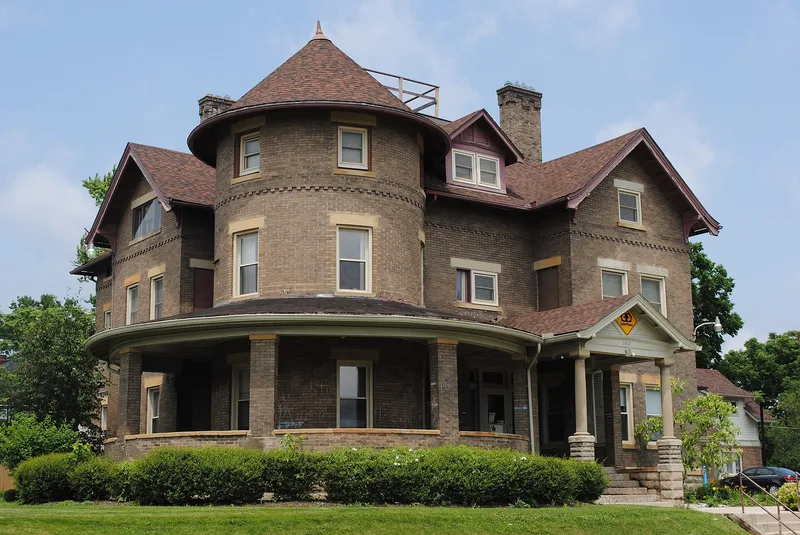
Built between about 1905 and 1910, this thirty-room gray brick house at 1421 Hamlet Street in Columbus was home to Felix A. Jacobs, his brother and his sister. Its dominant feature is a 19-foot-diameter round corner tower rising three stories under a conical roof, with a concentric porch at its base. A carriage house and a small round brick outbuilding stand nearby. Jacobs co-founded the Kilbourne and Jacobs Manufacturing Company, a maker of wheelbarrows, scrapers and other earth-moving equipment sold around the world. While serving as Director of Public Improvements in 1897-98, he had an iron conduit built to supply the city with artesian well water, relieving a water shortage. The house originally featured an electric telephone system and a double furnace and boiler. Later divided into apartments, it now serves as a youth crisis center, though its first-floor interior details remain largely intact.
Significance in brief: The house is significant for its architecture, especially its 19-foot-diameter three-story corner tower, and for Felix Jacobs' role in local industry and politics. Jacobs co-founded the Kilbourne and Jacobs Manufacturing Company and, as Director of Public Improvements, was largely responsible for the Jacobs Conduit, the city's first source of safe drinking water. The house also was a showplace of up-to-date heating, electrical and telephone systems.
Machine-generated summary. This summary was generated by a language model from the official nomination document and has not been reviewed line by line by an editor. It may contain errors. Check the source document before relying on any detail. Source: nomination document (PDF) · National Archives catalog entry. NRHP reference 86003434, listed December 19, 1986. Summary generated October 2026 (model claude-sonnet-5-5, prompt v1.0-2026-10-29, confidence high).
Key facts
| Address | 1421 Hamlet St., Columbus |
|---|---|
| County | Franklin County |
| Listed | December 19, 1986 |
| Reference number | 86003434 |
| Resource type | Building |
| Period of significance | 1900- (specific dates c. 1905-1910) |
| Architectural style | Queen Anne (noted in the reviewer's comments) |
| Criteria |
|
| Areas of significance | Industry, Architecture |
| Level of significance | Local |
| Status (as stated in the nomination) | Occupied; used as a crisis counseling center and shelter for troubled youths. It was divided into eleven apartments between 1966 and 1976, and the form rates its condition as good and altered. |
| Acreage | 0.9 |
| Coordinates | 39.99462, -83.00057 (NPS GIS) |
What listing means for this property
National Register listing is honorary for a privately owned home: it does not by itself restrict what an owner may do with their own money, and it does not require public access. Restrictions come from local landmark or historic-district ordinances, which are separate (how they differ).
Owner-occupied houses are not eligible for the 20% federal rehabilitation tax credit, which applies to income-producing buildings, but many states offer credits for homeowners. Listing also opens the door to preservation easements and to buying a plaque. Start with what listing means for homeowners, renovating a listed house and selling one.
General information, not legal or tax advice. Rules change; confirm with your State Historic Preservation Office or a qualified adviser.
Sources and further reading
- National Park Service, National Register of Historic Places database (snapshot May 2026), reference 86003434.
- Nomination form (PDF, National Archives) — catalog entry
- Wikipedia article (used for cross-checking only; text not reproduced here)
- Wikidata Q104782676
- This listing as JSON
Last updated October 2026. Found an error? See the editorial policy for how to report it.