Melville-Milne, William Gordon, House

Why it's listed
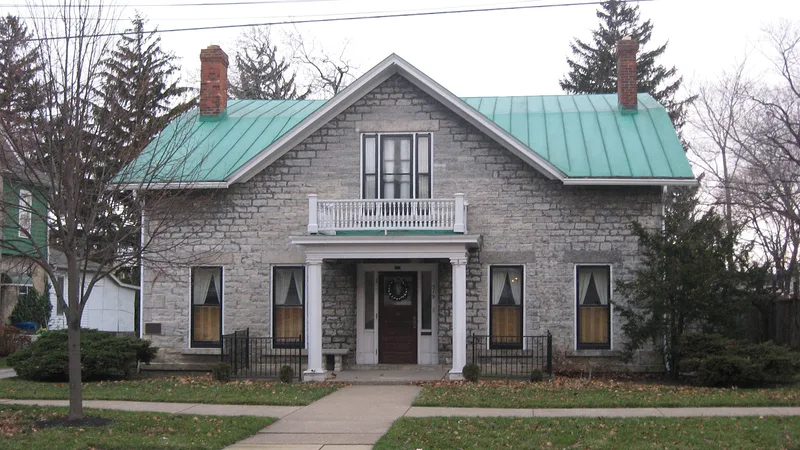
Built around 1840 at 319 Lawrence Street in Sandusky, this limestone-fronted cottage was constructed by the Mad River and Lake Erie Railroad, Ohio's first railroad, as employee housing. The stone came from a nearby Washington Street quarry. It is named for William Gordon Melville-Milne, a Scottish-born railroad employee who settled in Sandusky in 1847. His widow raised eight children there, and his son James, later the city's postmaster, became sole owner. In 1912 Frederick Emmons, a paper company executive, remodeled it, adding a stuccoed rear wing, a Tuscan-columned porch and a shallow gambrel roof, nearly doubling its size. Limestone houses are common in Sandusky, but this one's central gable, wide eaves and low roof make it unusual locally. Its design, railroad connection and ownership by representative townspeople led to its recognition as a local landmark.
Significance in brief: The nomination argues the house is significant for its unusual cottage design, with a central gable, wide eaves and low roof, within Sandusky's common limestone building tradition. It is also one of several residences built as employee housing by Ohio's first railroad. Its owners were representative Sandusky citizens.
Machine-generated summary. This summary was generated by a language model from the official nomination document and has not been reviewed line by line by an editor. It may contain errors. Check the source document before relying on any detail. Source: nomination document (PDF) · National Archives catalog entry. NRHP reference 79001828, listed March 28, 1979. Summary generated October 2026 (model claude-sonnet-5-5, prompt v1.0-2026-10-29, confidence high).
Key facts
| Address | 319 Lawrence St., Sandusky |
|---|---|
| County | Erie County |
| Listed | March 28, 1979 |
| Reference number | 79001828 |
| Resource type | Building |
| Period of significance | 1800-1899 |
| Architect / builder | Mad River and Lake Erie Railroad (builder) |
| Areas of significance | Architecture, Social History |
| Level of significance | Local |
| Status (as stated in the nomination) | Occupied as a private residence; altered in 1912 but the interior is described as intact apart from later redecoration. |
| Acreage | 0.9 |
| Coordinates | 41.45200, -82.71705 (NPS GIS) |
What listing means for this property
National Register listing is honorary for a privately owned home: it does not by itself restrict what an owner may do with their own money, and it does not require public access. Restrictions come from local landmark or historic-district ordinances, which are separate (how they differ).
Owner-occupied houses are not eligible for the 20% federal rehabilitation tax credit, which applies to income-producing buildings, but many states offer credits for homeowners. Listing also opens the door to preservation easements and to buying a plaque. Start with what listing means for homeowners, renovating a listed house and selling one.
General information, not legal or tax advice. Rules change; confirm with your State Historic Preservation Office or a qualified adviser.
Sources and further reading
- National Park Service, National Register of Historic Places database (snapshot May 2026), reference 79001828.
- Nomination form (PDF, National Archives) — catalog entry
- Wikidata Q137771058
- This listing as JSON
Last updated October 2026. Found an error? See the editorial policy for how to report it.