Southworth House
Also known as: Delta Sigma Phi Fraternity

Why it's listed
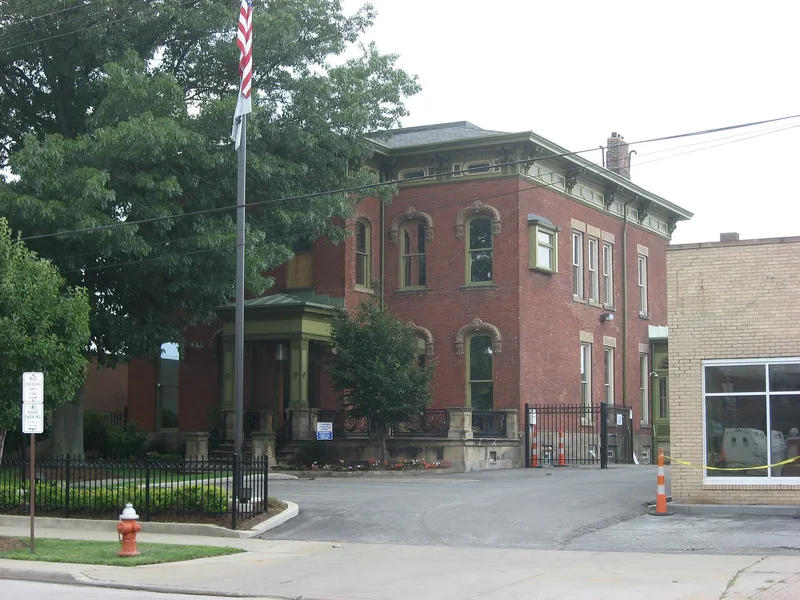
Built about 1879 at 3334 Prospect Avenue in Cleveland, this two-story brick house is an example of Italianate residential design. Its features include a cornice with paired brackets set between small eyelet windows, segmented-arch windows topped by stone hoods, and a double-door entrance. A Neo Classic front porch and a one-story enclosed side porch were added in 1895. A two-story Tudor Revival carriage house stands behind the house and is vacant and in poor condition. The house was built for W.P. Southworth, who owned a wholesale and retail grocery company and served as president of the National City Bank from 1879 to 1889. His wife, Louisa Southworth, was active in the local woman suffrage movement, wrote articles on the subject, and in 1893 led local efforts to gather signatures supporting women's right to vote. She lived there until her death in 1905. The house is one of few surviving Post Civil War residences on Cleveland's near east side.
Significance in brief: The nomination argues the house is a good representative example of Italianate residential architecture, with its bracketed cornice, eyelet windows and ornate stone hood molds. It is also one of the few remaining Post Civil War houses on Cleveland's near east side. It was the home of businessman William Southworth and of Louisa Southworth, who was active in the local woman suffrage movement.
Machine-generated summary. This summary was generated by a language model from the official nomination document and has not been reviewed line by line by an editor. It may contain errors. Check the source document before relying on any detail. Source: nomination document (PDF) · National Archives catalog entry. NRHP reference 84000234, listed November 1, 1984. Summary generated October 2026 (model claude-sonnet-5-5, prompt v1.0-2026-10-29, confidence medium).
Key facts
| Address | 3334 Prospect Ave., Cleveland |
|---|---|
| County | Cuyahoga County |
| Listed | November 1, 1984 |
| Reference number | 84000234 |
| Resource type | Building |
| Architectural style | Italianate |
| Areas of significance | Commerce, Architecture |
| Level of significance | Local |
| Status (as stated in the nomination) | House in good exterior condition and used as a fraternity house; the rear Tudor Revival carriage house is vacant and in poor condition. |
| Acreage | 0.9 |
| Within district | Midtown Historic District |
| Coordinates | 41.50119, -81.66325 (NPS GIS) |
What listing means for this property
National Register listing is honorary for a privately owned home: it does not by itself restrict what an owner may do with their own money, and it does not require public access. Restrictions come from local landmark or historic-district ordinances, which are separate (how they differ).
Owner-occupied houses are not eligible for the 20% federal rehabilitation tax credit, which applies to income-producing buildings, but many states offer credits for homeowners. Listing also opens the door to preservation easements and to buying a plaque. Start with what listing means for homeowners, renovating a listed house and selling one.
General information, not legal or tax advice. Rules change; confirm with your State Historic Preservation Office or a qualified adviser.
Sources and further reading
- National Park Service, National Register of Historic Places database (snapshot May 2026), reference 84000234.
- Nomination form (PDF, National Archives) — catalog entry
- Wikipedia article (used for cross-checking only; text not reproduced here)
- Wikidata Q2304810
- This listing as JSON
Last updated October 2026. Found an error? See the editorial policy for how to report it.