Euclid Avenue Historic District

Why it's listed
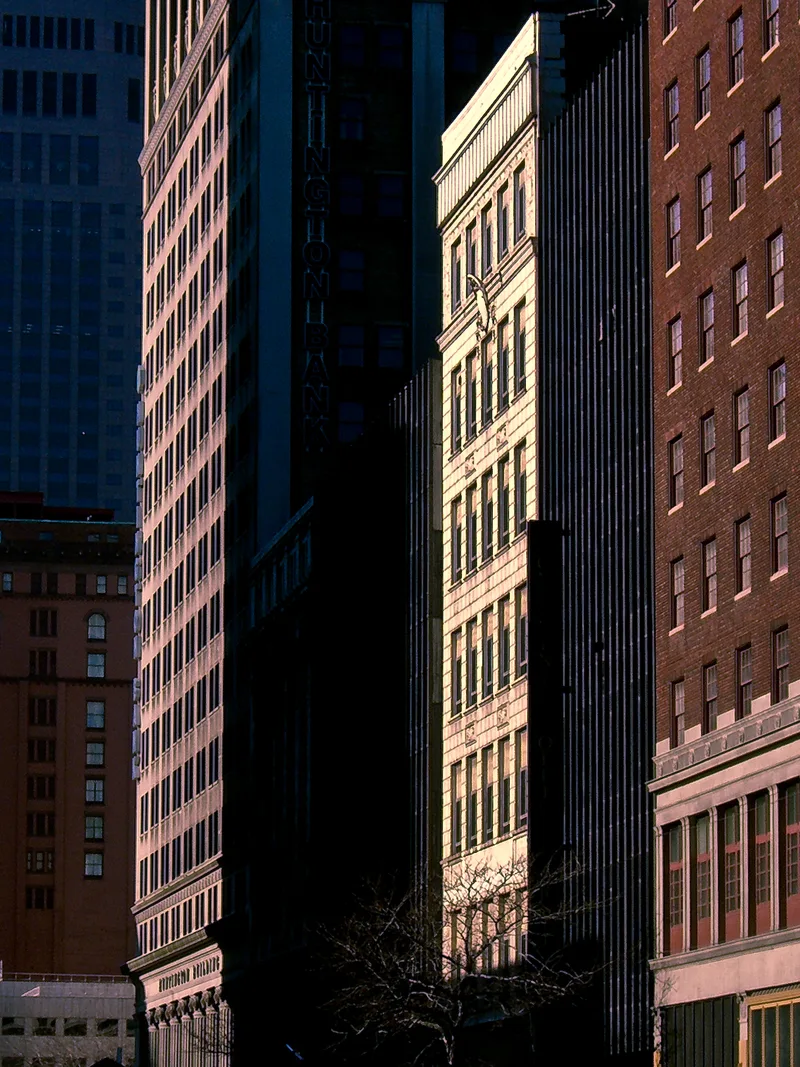
Euclid Avenue in downtown Cleveland is the setting for this commercial historic district, which extends east from Public Square to East 17th and East 21st Streets. It contains 36 contributing and 18 noncontributing buildings and three objects built between 1870 and 1952, including the Arcade, Old Stone Church, the Halle Building, the Terminal Tower Group and the Cleveland Trust Rotunda. Styles range from Neo-classical and Commercial to Renaissance Revival, Romanesque, Beaux-Arts and Art Deco, and building heights run from two to eighteen stories. Cornices and window patterns tie the varied buildings together. The avenue was once Millionaires' Row, lined with large private houses, but rising taxes and commercial growth led owners to demolish or sell them. By the 1960s it had become the main route for the city's commerce between Public Square and University Circle. Retail stores, banks, hotels and theaters by architects such as Burnham, Post, Bacon and Walker and Weeks record that change.
Significance in brief: The district is significant for its role in Cleveland's commerce and transportation, for its architecture, and for community planning and development. Euclid Avenue changed from a residential street of mansions known as Millionaires' Row into the city's main commercial artery. Its mix of banks, department stores, arcades, hotels and theaters by prominent architects creates a cohesive streetscape.
Machine-generated summary. This summary was generated by a language model from the official nomination document and has not been reviewed line by line by an editor. It may contain errors. Check the source document before relying on any detail. Source: nomination document (PDF) · National Archives catalog entry. NRHP reference 02000702, listed June 28, 2002. Summary generated October 2026 (model claude-sonnet-5-5, prompt v1.0-2026-10-29, confidence medium).
Key facts
| Address | Roughly bounded by Public Square, Euclid Ave. to E. 17th St., E. 21st St., Cleveland |
|---|---|
| County | Cuyahoga County |
| Listed | June 28, 2002 |
| Reference number | 02000702 |
| Resource type | District |
| Period of significance | 1870-1952 |
| Architect / builder | George E. Post; Henry Bacon; Walker and Weeks; Daniel Burnham; Charles Schweinfurth; Hubbell and Benes; Graham, Anderson, Probst and White; Frank S. Barnum; Walter Blythe; George Smith; Franz Warner |
| Architectural style | Late 19th and Early 20th Century Revivals; Late 19th and Early 20th Century American Movements (mainly Neo-classical and Commercial style, with Renaissance Revival, Romanesque, Jacobean, Beaux-Arts and Art Deco) |
| Criteria |
|
| Areas of significance | Transportation, Architecture, Commerce |
| Level of significance | Local |
| Status (as stated in the nomination) | Historic and current functions include commercial, financial, social, educational, domestic and religious uses. The form notes 31 resources already individually listed in the National Register. |
| Acreage | 125 |
| Coordinates | 41.49804, -81.69142 (NPS GIS) |
What listing means for this property
This is a historic district. Buildings within its boundary are either contributing (they add to the district's significance) or non-contributing. Owners of contributing income-producing buildings can claim the 20% federal rehabilitation tax credit; homeowners should look at state credits. National Register districts impose no design review by themselves; a local historic district ordinance, if one exists, does (the difference explained).
General information, not legal or tax advice. Rules change; confirm with your State Historic Preservation Office or a qualified adviser.
Sources and further reading
- National Park Service, National Register of Historic Places database (snapshot May 2026), reference 02000702.
- Nomination form (PDF, National Archives) — catalog entry
- Wikipedia article (used for cross-checking only; text not reproduced here)
- Wikidata Q5406099
- This listing as JSON
Last updated October 2026. Found an error? See the editorial policy for how to report it.