Rankin, John, House
Also known as: State Memorial

Why it's listed
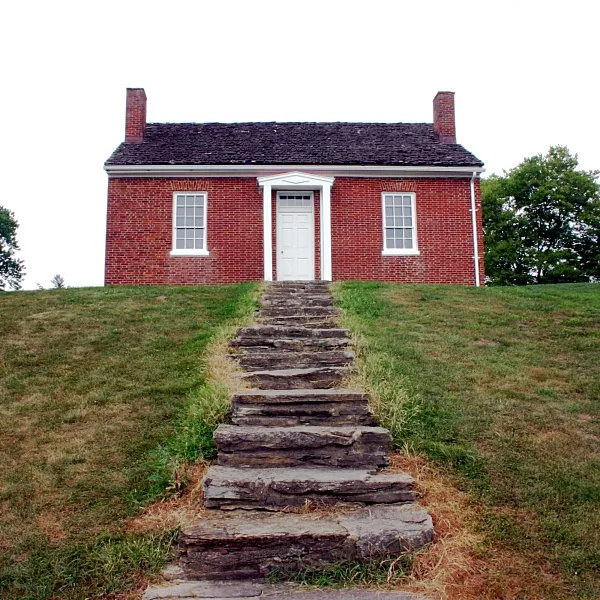
Perched on Liberty Hill above the Ohio River at Ripley, this 1-1/2 story brick house was the home of the Rev. John Rankin, an abolitionist leader and early conductor of the Underground Railroad. The house is a plain vernacular building, 35 feet square, with a gabled roof, two chimneys at each end, and four main-floor rooms: parlor, drawing room, dining room and kitchen. Bedrooms fill the upper floor. Rankin preached against slavery from 1815, and his 1826 book Letters on American Slavery influenced antislavery opinion. From the 1820s he and others sheltered fleeing slaves, and as many as twelve were hidden in the house at once. The family never lost a passenger. Harriet Beecher Stowe heard the story of Eliza here, later using it in Uncle Tom's Cabin. Ohio bought the house in 1938, restored it, and dedicated it as a state memorial in 1948. Much of the interior woodwork is original, and the stairway up the hill has been rebuilt.
Significance in brief: The house was the home of Rev. John Rankin, a leading Ohio abolitionist and one of the first and most active conductors of the Underground Railroad. Rankin's 1826 book Letters on American Slavery helped build antislavery sentiment. Fugitives were hidden in the house, and Harriet Beecher Stowe heard there the story of "Eliza" that she later used in Uncle Tom's Cabin.
Machine-generated summary. This summary was generated by a language model from the official nomination document and has not been reviewed line by line by an editor. It may contain errors. Check the source document before relying on any detail. Source: nomination document (PDF) · National Archives catalog entry. NRHP reference 70000485, listed November 10, 1970. Summary generated October 2026 (model claude-sonnet-5-5, prompt v1.0-2026-10-29, confidence high).
Key facts
| Address | E of Ripley, Liberty Hill, Ripley |
|---|---|
| County | Brown County |
| Listed | November 10, 1970 |
| Reference number | 70000485 |
| Resource type | Building |
| Architectural style | Vernacular, with little detailing or decoration |
| Areas of significance | Social History |
| Level of significance | State |
| National Historic Landmark | Yes, designated February 18, 1997 |
| Status (as stated in the nomination) | Excellent condition; restored and strengthened inside and out, owned by the State of Ohio and open to the public as a museum, furnished with Rankin family items. |
| Acreage | 20 |
| Coordinates | 38.75170, -83.84128 (NPS GIS) |
What listing means for this property
National Register listing is honorary for a privately owned home: it does not by itself restrict what an owner may do with their own money, and it does not require public access. Restrictions come from local landmark or historic-district ordinances, which are separate (how they differ).
Owner-occupied houses are not eligible for the 20% federal rehabilitation tax credit, which applies to income-producing buildings, but many states offer credits for homeowners. Listing also opens the door to preservation easements and to buying a plaque. Start with what listing means for homeowners, renovating a listed house and selling one.
General information, not legal or tax advice. Rules change; confirm with your State Historic Preservation Office or a qualified adviser.
Sources and further reading
- National Park Service, National Register of Historic Places database (snapshot May 2026), reference 70000485.
- Nomination form (PDF, National Archives) — catalog entry
- Wikipedia article (used for cross-checking only; text not reproduced here)
- Wikidata Q6254238
- This listing as JSON
Last updated October 2026. Found an error? See the editorial policy for how to report it.