Parker, John P., House

Why it's listed
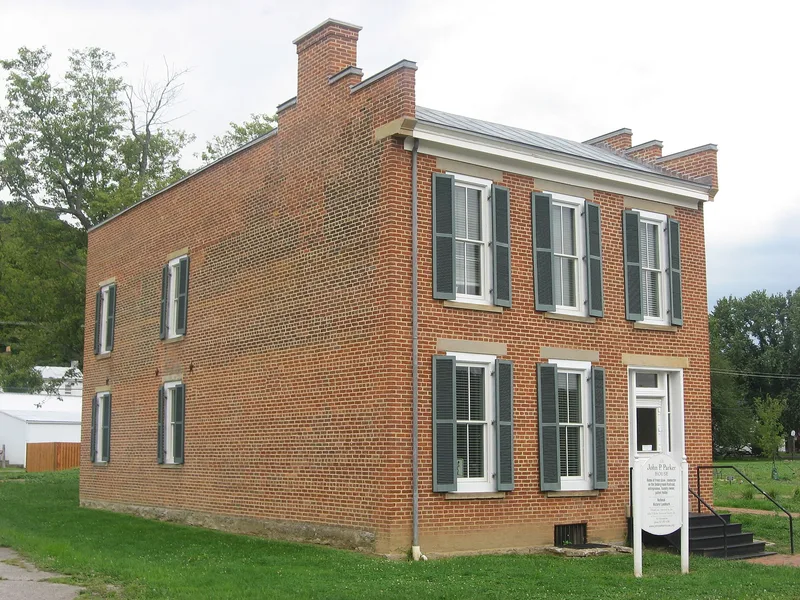
Overlooking the Ohio River at 300 Front Street in Ripley, this two-story brick house was built around 1850 in an L shape, with a wooden addition from the later nineteenth century filling the corner. It has a three-bay front, a cast-iron stoop, a Victorian door with sidelights and transom, and an interior walnut stairway with turned banisters. It was the home of John P. Parker from about 1865 until his death in 1900. Parker, a freedman from Mobile, Alabama, arrived in Ripley in 1850 and scouted both sides of the Ohio River to guide runaway slaves, and is credited with aiding about 900 escapes. He opened a small foundry in 1854 and founded the Phoenix Foundry and Machine Shop in 1866, producing his own agricultural inventions, including the Parker Pulverizer. He held patents at a time when few Black inventors did. The house has deteriorated and is used for storage.
Significance in brief: The house is tied to John P. Parker, a Black abolitionist, inventor and industrialist in Ripley. Parker is credited with helping about 900 slaves escape and ran the Phoenix Foundry and Machine Shop. He was one of the few Black inventors to obtain patents before 1900.
Machine-generated summary. This summary was generated by a language model from the official nomination document and has not been reviewed line by line by an editor. It may contain errors. Check the source document before relying on any detail. Source: nomination document (PDF) · National Archives catalog entry. NRHP reference 80002944, listed January 7, 1980. Summary generated October 2026 (model claude-sonnet-5-5, prompt v1.0-2026-10-29, confidence high).
Key facts
| Address | 300 Front St., Ripley |
|---|---|
| County | Brown County |
| Listed | January 7, 1980 |
| Reference number | 80002944 |
| Resource type | Building |
| Period of significance | 1800-1899 |
| Areas of significance | Industry, Social History, Invention |
| Level of significance | National |
| Status (as stated in the nomination) | Described as deteriorated and unoccupied; used for storage by the coal company owner, not maintained and not heated in winter. A marble mantel has fallen through the floor. |
| Acreage | 0.9 |
| Within district | Ripley Historic District |
| Coordinates | 38.75014, -83.84922 (NPS GIS) |
What listing means for this property
National Register listing is honorary for a privately owned home: it does not by itself restrict what an owner may do with their own money, and it does not require public access. Restrictions come from local landmark or historic-district ordinances, which are separate (how they differ).
Owner-occupied houses are not eligible for the 20% federal rehabilitation tax credit, which applies to income-producing buildings, but many states offer credits for homeowners. Listing also opens the door to preservation easements and to buying a plaque. Start with what listing means for homeowners, renovating a listed house and selling one.
General information, not legal or tax advice. Rules change; confirm with your State Historic Preservation Office or a qualified adviser.
Sources and further reading
- National Park Service, National Register of Historic Places database (snapshot May 2026), reference 80002944.
- Nomination form (PDF, National Archives) — catalog entry
- Wikipedia article (used for cross-checking only; text not reproduced here)
- Wikidata Q6251677
- This listing as JSON
Last updated October 2026. Found an error? See the editorial policy for how to report it.