Georgetown Historic District

Why it's listed
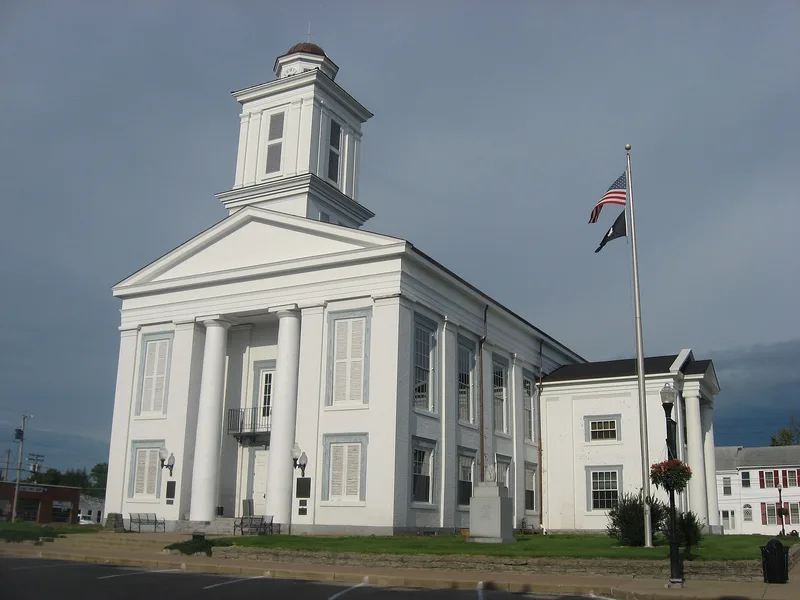
Georgetown's historic district occupies the downtown square of the Brown County seat in southern Ohio. At its center is the brick courthouse, completed in 1851 to designs by Hubbard Baker, a Greek Revival building with Doric columns and a recessed portico. It is described as the oldest Greek Revival courthouse still standing in the state. A fire in June 1977 destroyed the tower and part of the roof, and local citizens were raising funds for restoration. Around the square, the west side holds a late Victorian commercial row with bracketed cornices, cast iron columns and pressed tin fronts. The east side has colonial row houses built between 1826 and 1855, including a Masonic lodge from 1846 and a former schoolhouse. One small brick building was a school attended by Ulysses S. Grant. The town also supplied thirteen Union generals during the Civil War. Together the buildings show a century of architectural change in a largely intact county-seat downtown.
Significance in brief: The district is described as a virtually intact downtown of an early county seat, with a late Victorian commercial row on the west side of the square and early to mid-1800s colonial row houses on the east. The courthouse, designed by Hubbard Baker, is called the oldest Greek Revival courthouse still standing in the state. The area also has ties to Ulysses S. Grant's schooling and to the many Civil War generals from Georgetown.
Machine-generated summary. This summary was generated by a language model from the official nomination document and has not been reviewed line by line by an editor. It may contain errors. Check the source document before relying on any detail. Source: nomination document (PDF) · National Archives catalog entry. NRHP reference 78002011, listed May 23, 1978. Summary generated October 2026 (model claude-sonnet-5-5, prompt v1.0-2026-10-29, confidence medium).
Key facts
| Address | Roughly bounded by Water Alley, Pleasant, Short, and State Sts., Georgetown |
|---|---|
| County | Brown County |
| Listed | May 23, 1978 |
| Reference number | 78002011 |
| Resource type | District |
| Period of significance | 1800-1899 |
| Architect / builder | Hubbard Baker (courthouse architect and builder) |
| Architectural style | Greek Revival, Late Victorian commercial, and early colonial/Federal style row houses |
| Areas of significance | Commerce, Politics/Government, Architecture |
| Level of significance | State |
| Status (as stated in the nomination) | Condition is rated excellent to good. A June 1977 fire destroyed the courthouse tower and part of its roof, and restoration was under consideration. The courthouse was otherwise described as structurally sound. |
| Acreage | 17 |
| Coordinates | 38.86564, -83.90385 (NPS GIS) |
What listing means for this property
This is a historic district. Buildings within its boundary are either contributing (they add to the district's significance) or non-contributing. Owners of contributing income-producing buildings can claim the 20% federal rehabilitation tax credit; homeowners should look at state credits. National Register districts impose no design review by themselves; a local historic district ordinance, if one exists, does (the difference explained).
General information, not legal or tax advice. Rules change; confirm with your State Historic Preservation Office or a qualified adviser.
Sources and further reading
- National Park Service, National Register of Historic Places database (snapshot May 2026), reference 78002011.
- Nomination form (PDF, National Archives) — catalog entry
- Wikipedia article (used for cross-checking only; text not reproduced here)
- Wikidata Q5547001
- This listing as JSON
Last updated October 2026. Found an error? See the editorial policy for how to report it.