Polk, Leonidas L., House
Polk, Leonidas L., House is a building in Raleigh, Wake County, North Carolina, listed on the National Register of Historic Places on April 13, 1977 (reference number 77001012). The National Park Service records its significance in Agriculture and Politics/Government at the national level.
Facts from the NPS National Register database (); nomination summary October 2026. Last updated . Sources for each fact.

Approximate location: the National Park Service places this pin arbitrarily within the property, not at a surveyed point (stated accuracy ±12 m).
Why it's listed
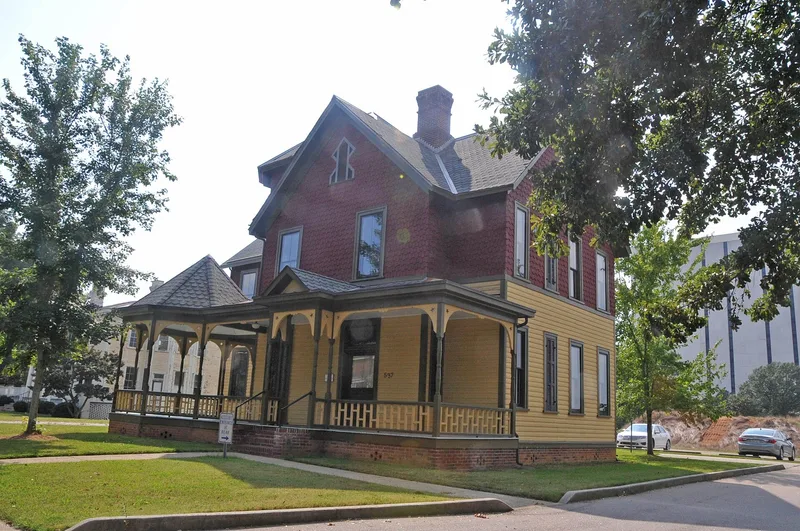
This two-story frame house in Raleigh was built about 1891 as the home of Leonidas L. Polk and his wife Sarah. Polk was North Carolina's first Commissioner of Agriculture, founded and edited the Progressive Farmer, helped establish what is now North Carolina State University, and served as president of the National Farmers' Alliance. The house is described as the best surviving reminder of his career in Raleigh. Its late Victorian Shingle Style design includes a corner turret, a front porch with star-shaped sawnwork ornament, and a main stair with a Chinese Chippendale-derived balustrade. Originally on Person Street, it was moved in the 1960s to avoid demolition from commercial development, losing its original porches and two wings. A 1999 approval allowed a further move to the 500 block of North Blount Street, with restoration planned for office and museum use. The historic core remained largely unaltered.
Significance in brief: The house is tied to Leonidas L. Polk, described as the most effective champion of agricultural reform in North Carolina history and a central figure in national reform politics of the early 1890s. It is called Raleigh's most vivid reminder of him and is also noted for its Shingle Style design, corner turret and interior stair.
Machine-generated summary. This summary was generated by a language model from the official nomination document and has not been reviewed line by line by an editor. It may contain errors. Check the source document before relying on any detail. Source: nomination document (PDF) · National Archives catalog entry. NRHP reference 77001012, listed April 13, 1977. Summary generated October 2026 (model claude-sonnet-5-5, prompt v1.0-2026-10-29, confidence medium).
Key facts
| Official database NPS National Register database, ref. 77001012 , checked | |
|---|---|
| Address | 612 N. Blount St., Raleigh |
| County | Wake County |
| Listed | April 13, 1977 |
| Reference number | 77001012 |
| Resource type | Building |
| Areas of significance | Agriculture, Politics/Government |
| Level of significance | National |
| National Historic Landmark | No |
| Acreage | 0.9 |
| Official document, machine-extracted Nomination form (National Archives) , checked | |
| Period of significance | 1800-1899 (specific date ca. 1891) |
| Architectural style | Late Victorian Shingle Style |
| Status (as stated in the nomination) | Moved in the early-to-mid 1960s to the rear of 612 North Blount Street, where it was reported poorly maintained. A 1999 request approved a second move about 500 feet southwest, with restoration planned for office and museum use. |
| Official dataset NPS cultural-resource GIS (NRHP locations) | |
| Coordinates | 35.78843, -78.63566 |
| Computed Computed from NPS GIS district boundaries | |
| Within district | Oakwood Historic District |
What listing means for this property
National Register listing is honorary for a privately owned home: it does not by itself restrict what an owner may do with their own money, and it does not require public access. Restrictions come from local landmark or historic-district ordinances, which are separate (how they differ).
Owner-occupied houses are not eligible for the 20% federal rehabilitation tax credit, which applies to income-producing buildings, but many states offer credits for homeowners. Listing also opens the door to preservation easements and to buying a plaque. Start with what listing means for homeowners, renovating a listed house and selling one.
General information, not legal or tax advice. Rules change; confirm with your State Historic Preservation Office or a qualified adviser.
Questions about Polk, Leonidas L., House
When was Polk, Leonidas L., House added to the National Register of Historic Places?
Polk, Leonidas L., House was listed on April 13, 1977. Its National Register reference number is 77001012.
Is Polk, Leonidas L., House a National Historic Landmark?
No. The National Park Service database (snapshot of May 2026) lists Polk, Leonidas L., House on the National Register but does not record it as a National Historic Landmark.
Where is Polk, Leonidas L., House?
612 N. Blount St., Raleigh, Wake County, North Carolina; coordinates 35.78843, -78.63566.
Why is Polk, Leonidas L., House historically significant?
According to a machine-generated summary of its nomination form: The house is tied to Leonidas L. Polk, described as the most effective champion of agricultural reform in North Carolina history and a central figure in national reform politics of the early 1890s. It is called Raleigh's most vivid reminder of him and is also noted for its Shingle Style design, corner turret and interior stair. Check the nomination document before relying on any detail.
Is Polk, Leonidas L., House in a historic district?
Yes. Its location falls within the Oakwood Historic District, itself listed on the National Register. (Computed from National Park Service boundary data; the district nomination's own list of contributing resources may differ.)
Where can I read the original nomination for Polk, Leonidas L., House?
The nomination form is a public record held by the National Archives: nomination document (PDF).
Sources and further reading
- National Park Service, National Register of Historic Places database (snapshot May 2026), reference 77001012.
- Nomination form (PDF, National Archives) — catalog entry
- Wikipedia article (used for cross-checking only; text not reproduced here)
- Wikidata Q21016116
- This listing as JSON
Last updated November 2026. Found an error? See the editorial policy for how to report it.