Grimes Mill

Why it's listed
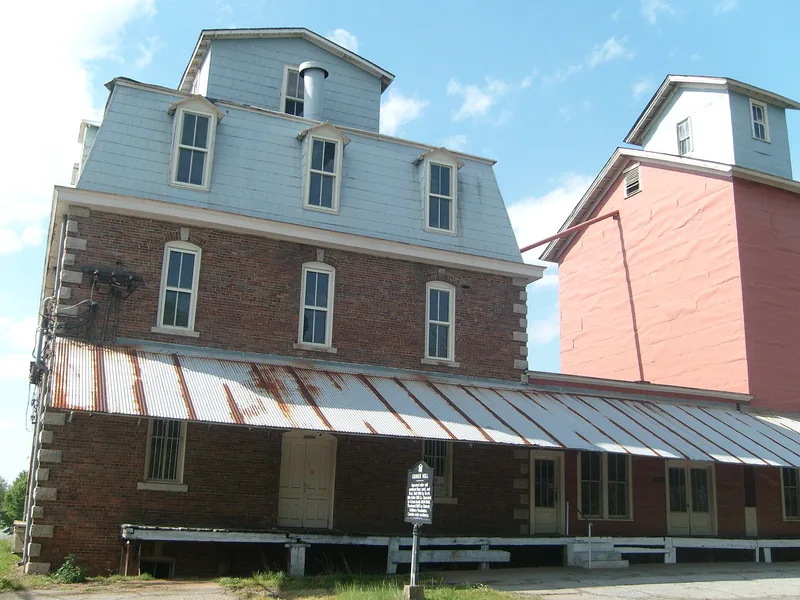
Grimes Mill, at 600 North Church Street in Salisbury, is a three-story brick flour mill trimmed with granite and topped by a mansard roof, dormers and a cupola. Built in 1896-97 as the North Side Roller Mill, it was organized by local businessmen including D. R. Julian and brothers James and Napoleon B. McCanless. John D. Grimes bought it at a bankruptcy sale in 1906, and his family ran it until 1963. Later operators kept it working until 1982. Frame additions, including a grain elevator, were added over time, but the original block survives with most of its belt-driven roller mills, sifters, scourers and packing machinery. The building is considered one of very few Second Empire style industrial buildings in North Carolina. It was listed for its architecture, for its link to the late nineteenth-century industrialization of the piedmont and the agricultural economy of Rowan County, and for its association with its builders and the Grimes milling family. The Historic Salisbury Foundation planned to open it as a mill museum.
Significance in brief: The nomination argues it is a rare North Carolina example of Second Empire style industrial architecture, with an intact original structure and most of its early twentieth-century belt-driven machinery. It is also tied to the industrialization of the piedmont, to its builders N. B. McCanless and D. R. Julian, and to the Grimes milling family, who ran it from 1906 to 1963. It operated continuously until 1982.
Machine-generated summary. This summary was generated by a language model from the official nomination document and has not been reviewed line by line by an editor. It may contain errors. Check the source document before relying on any detail. Source: nomination document (PDF) · National Archives catalog entry. NRHP reference 84002492, listed February 6, 1984. Summary generated October 2026 (model claude-sonnet-5-5, prompt v1.0-2026-10-29, confidence high).
Key facts
| Address | 600 N. Church St., Salisbury |
|---|---|
| County | Rowan County |
| Listed | February 6, 1984 |
| Reference number | 84002492 |
| Resource type | Building |
| Period of significance | 1800-1899 |
| Architect / builder | Unknown |
| Architectural style | Second Empire |
| Criteria |
|
| Areas of significance | Industry, Architecture |
| Level of significance | Local |
| Status (as stated in the nomination) | Operated as a mill until 1982, when the Historic Salisbury Foundation bought it, planning to reopen it as a working mill museum; the original machinery largely remains. |
| Acreage | 0.8 |
| Coordinates | 35.67303, -80.46542 (NPS GIS) |
What listing means for this property
For an income-producing building, listing (individually or as a contributing building in a district) is the gateway to the 20% federal rehabilitation tax credit on qualified rehabilitation costs, often stackable with state credits. Work claiming the credit must follow the Secretary of the Interior's Standards and be approved in advance.
Listing does not restrict a private owner acting without federal money or permits; where federal funding or licensing is involved, Section 106 review applies.
General information, not legal or tax advice. Rules change; confirm with your State Historic Preservation Office or a qualified adviser.
Sources and further reading
- National Park Service, National Register of Historic Places database (snapshot May 2026), reference 84002492.
- Nomination form (PDF, National Archives) — catalog entry
- Wikipedia article (used for cross-checking only; text not reproduced here)
- Wikidata Q5609251
- This listing as JSON
Last updated October 2026. Found an error? See the editorial policy for how to report it.