Saluda Main Street Historic District

Why it's listed
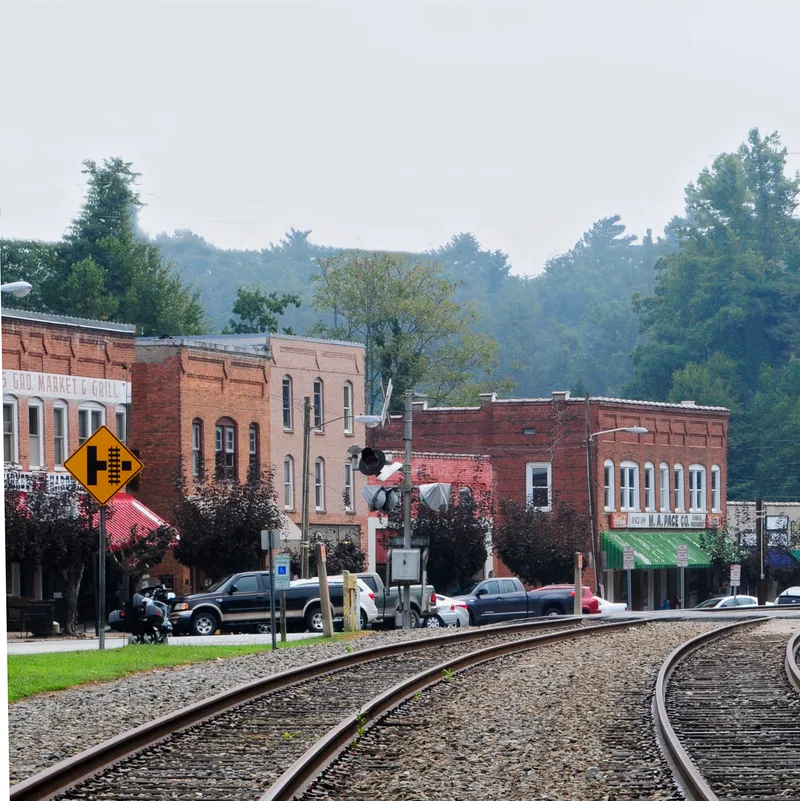
Main Street in Saluda, North Carolina, forms a compact linear district of 24 resources beside the railroad tracks at the top of the Saluda Grade. Most are one- or two-story red brick commercial buildings from about 1900 to 1935, with stepped parapets, recessed entrances and corbeled cornices. The M. A. Pace Store, built between 1905 and 1910, has stayed in family operation and keeps its board walls, original shelves and display cases. Other notable buildings include City Hall, with a rare pressed metal facade, the gable-fronted Pebbledash Building, a 1930s Standard Oil station, a Stick-style depot, and the Gothic Revival Saluda Presbyterian Church of 1895-96. The town grew because of the railroad, which reached it in 1878, and later flourished as a resort for visitors seeking mountain air. Although some storefronts have been altered and a few newer buildings have been added, the district still conveys the character of an early twentieth-century small-town commercial center.
Significance in brief: The district is the commercial core of a town created by the railroad at the top of the steep Saluda Grade. It keeps the look and feel of an early twentieth-century small-town business center, with intact commercial buildings such as the M. A. Pace Store. Its resources also illustrate Saluda's growth as a railroad town and health resort.
Machine-generated summary. This summary was generated by a language model from the official nomination document and has not been reviewed line by line by an editor. It may contain errors. Check the source document before relying on any detail. Source: nomination document (PDF) · National Archives catalog entry. NRHP reference 96000569, listed May 29, 1996. Summary generated October 2026 (model claude-sonnet-5-5, prompt v1.0-2026-10-29, confidence medium).
Key facts
| Address | Main St. from Cullipher St. to Carolina St., Saluda |
|---|---|
| County | Polk County |
| Listed | May 29, 1996 |
| Reference number | 96000569 |
| Resource type | District |
| Architectural style | Commercial Style; Stick; Late Gothic Revival |
| Areas of significance | Transportation, Commerce, Architecture |
| Level of significance | Local |
| Status (as stated in the nomination) | Most buildings remain in commercial use. Four have been substantially remodeled, and the former depot was moved into the district. City Hall and the Pebbledash Building have been restored. |
| Acreage | 5.2 |
| Coordinates | 35.23621, -82.34806 (NPS GIS) |
What listing means for this property
This is a historic district. Buildings within its boundary are either contributing (they add to the district's significance) or non-contributing. Owners of contributing income-producing buildings can claim the 20% federal rehabilitation tax credit; homeowners should look at state credits. National Register districts impose no design review by themselves; a local historic district ordinance, if one exists, does (the difference explained).
General information, not legal or tax advice. Rules change; confirm with your State Historic Preservation Office or a qualified adviser.
Sources and further reading
- National Park Service, National Register of Historic Places database (snapshot May 2026), reference 96000569.
- Nomination form (PDF, National Archives) — catalog entry
- Wikipedia article (used for cross-checking only; text not reproduced here)
- Wikidata Q22061080
- This listing as JSON
Last updated October 2026. Found an error? See the editorial policy for how to report it.