Jackson Historic District
Jackson Historic District is a historic district in Jackson, Northampton County, North Carolina, listed on the National Register of Historic Places on June 16, 2004 (reference number 04000606). The National Park Service records its significance in Commerce and Architecture at the local level.
Facts from the NPS National Register database (); nomination summary October 2026. Last updated . Sources for each fact.

The pin is a point inside the NPS boundary polygon, not a surveyed location.
Why it's listed
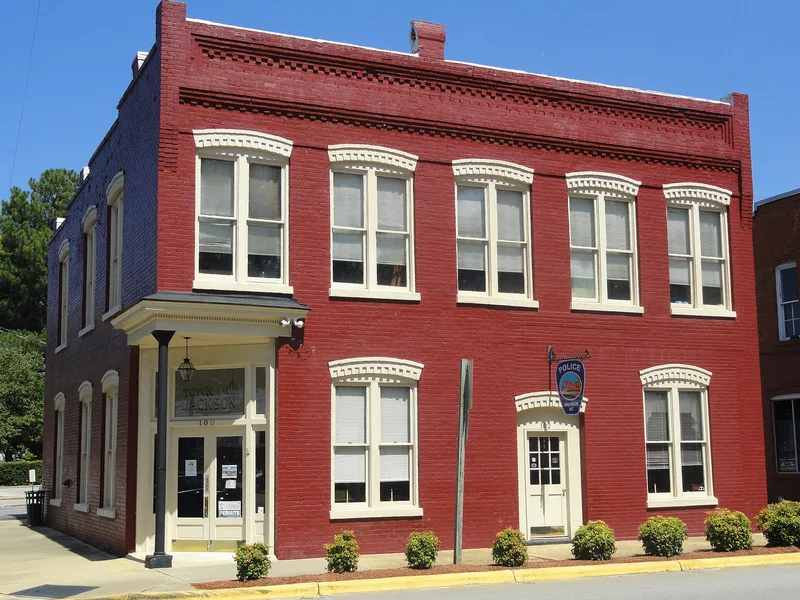
Jackson is the county seat of Northampton County in northeastern North Carolina, and its historic district covers about 110 acres of the town's grid of streets. The 1858 Greek Revival brick courthouse, one of the few surviving temple-form public buildings in the state, anchors the district. East and west of it, a three-block commercial district was rebuilt in brick after a 1925 fire. South of Jefferson Street, an industrial area centers on the Farmer's Cotton Gin Complex and a brick warehouse. North of the business district, houses span roughly 150 years, from the c. 1825 Faison House to Queen Anne cottages, Colonial Revival homes, bungalows and 1940s and 1950s Cape Cods. Churches include the 1898 granite Gothic Revival Church of the Saviour, designed by Adolphus Gustavus Bauer. The district includes 173 contributing resources and 56 noncontributing ones. Together with the surrounding farmland, these buildings convey Jackson's development over two centuries as a county seat and regional center.
Significance in brief: The district is described as retaining a significant assemblage of nineteenth- and early-to-mid-twentieth-century buildings that record Jackson's two centuries of development as Northampton's county seat. It includes a rare temple-form 1858 courthouse, a commercial district rebuilt after a 1925 fire, churches, an agricultural processing area and a range of houses.
Machine-generated summary. This summary was generated by a language model from the official nomination document and has not been reviewed line by line by an editor. It may contain errors. Check the source document before relying on any detail. Source: nomination document (PDF) · National Archives catalog entry. NRHP reference 04000606, listed June 16, 2004. Summary generated October 2026 (model claude-sonnet-5-5, prompt v1.0-2026-10-29, confidence medium).
Key facts
| Official database NPS National Register database, ref. 04000606 , checked | |
|---|---|
| Address | Roughly bounded by Atherton St., Picard St., Buxton St., and northern town limit line, Jackson |
| County | Northampton County |
| Listed | June 16, 2004 |
| Reference number | 04000606 |
| Resource type | District |
| Areas of significance | Commerce, Architecture |
| Level of significance | Local |
| National Historic Landmark | No |
| Acreage | 110 |
| Official document, machine-extracted Nomination form (National Archives) , checked | |
| Architect / builder | Adolphus Gustavus Bauer (Episcopal Church of the Saviour, 1898); Thomas Bragg Sr. (Amis-Bragg House, c. 1840); Frederick FitzGerald (cemetery design, 1853) |
| Architectural style | Federal, Greek Revival, Gothic Revival, Queen Anne, Colonial Revival, Bungalow/Craftsman, Modern Movement |
| Status (as stated in the nomination) | Still in active use as a county seat with commercial, government, religious and residential functions; some storefronts are being restored under a town revitalization program. |
| Official dataset NPS cultural-resource GIS (NRHP locations) | |
| Coordinates | 36.39337, -77.42304 |
What listing means for this property
This is a historic district. Buildings within its boundary are either contributing (they add to the district's significance) or non-contributing. Owners of contributing income-producing buildings can claim the 20% federal rehabilitation tax credit; homeowners should look at state credits. National Register districts impose no design review by themselves; a local historic district ordinance, if one exists, does (the difference explained).
General information, not legal or tax advice. Rules change; confirm with your State Historic Preservation Office or a qualified adviser.
Questions about Jackson Historic District
When was Jackson Historic District added to the National Register of Historic Places?
Jackson Historic District was listed on June 16, 2004. Its National Register reference number is 04000606.
Is Jackson Historic District a National Historic Landmark?
No. The National Park Service database (snapshot of May 2026) lists Jackson Historic District on the National Register but does not record it as a National Historic Landmark.
Where is Jackson Historic District?
Roughly bounded by Atherton St., Picard St., Buxton St., and northern town limit line, Jackson, Northampton County, North Carolina; coordinates 36.39337, -77.42304.
Why is Jackson Historic District historically significant?
According to a machine-generated summary of its nomination form: The district is described as retaining a significant assemblage of nineteenth- and early-to-mid-twentieth-century buildings that record Jackson's two centuries of development as Northampton's county seat. It includes a rare temple-form 1858 courthouse, a commercial district rebuilt after a 1925 fire, churches, an agricultural processing area and a range of houses. Check the nomination document before relying on any detail.
Who designed or built Jackson Historic District?
The nomination form names Adolphus Gustavus Bauer (Episcopal Church of the Saviour, 1898); Thomas Bragg Sr. (Amis-Bragg House, c. 1840); Frederick FitzGerald (cemetery design, 1853) as architect or builder (extracted by machine from the nomination; check the source document).
Where can I read the original nomination for Jackson Historic District?
The nomination form is a public record held by the National Archives: nomination document (PDF).
Sources and further reading
- National Park Service, National Register of Historic Places database (snapshot May 2026), reference 04000606.
- Nomination form (PDF, National Archives) — catalog entry
- Wikipedia article (used for cross-checking only; text not reproduced here)
- Wikidata Q19462572
- This listing as JSON
Last updated November 2026. Found an error? See the editorial policy for how to report it.