Rocky Mount Mills Village Historic District
Also known as: See also: Rocky Mount Mills 80002891

Why it's listed
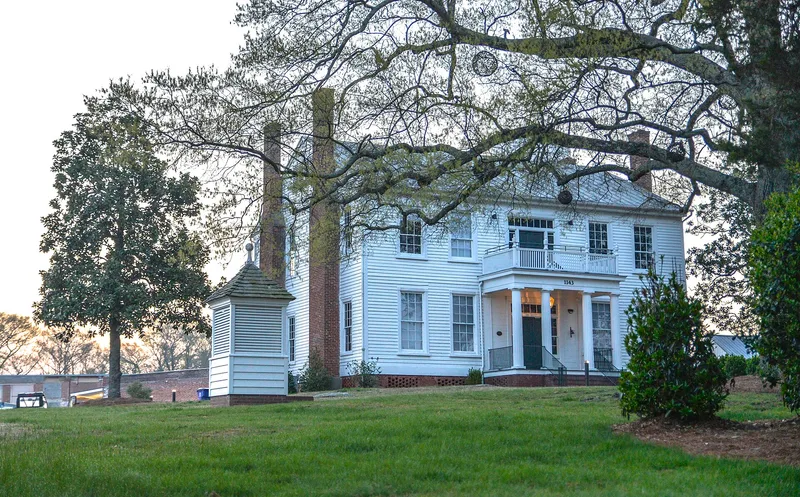
Rocky Mount Mills Village is a mill community on the south bank of the Tar River in Rocky Mount, North Carolina, built between 1835 and 1948. It grew around the second cotton mill established in the state, founded by local investors in 1818 and led for generations by the Battle family. The district includes brick mill buildings with Italianate features, a Greek Revival house from 1835 built for the mill owner, a Craftsman community house, and about sixty frame mill houses. The most common house is a one-story saddlebag built for workers between about 1888 and 1915, and five two-story duplexes survive at Falls Road and Elm Street. Because the mill company kept ownership of the housing, the village remained unusually intact, with its original street layout, lots and gardens. It was listed for its industrial and social history, its link to the Battle family, and its collection of mill and worker architecture. The mill closed in 1996.
Significance in brief: The nomination argues the district is one of the most intact mill villages in Piedmont North Carolina. It reflects the industrial and social history of a locally owned cotton mill with antebellum roots, the second cotton mill built in the state. It is also tied to the prominent Battle family and has Italianate mill buildings, manager houses and uniform worker houses.
Machine-generated summary. This summary was generated by a language model from the official nomination document and has not been reviewed line by line by an editor. It may contain errors. Check the source document before relying on any detail. Source: nomination document (PDF) · National Archives catalog entry. NRHP reference 99000479, listed April 22, 1999. Summary generated October 2026 (model claude-sonnet-5-5, prompt v1.0-2026-10-29, confidence medium).
Key facts
| Address | Bounded by Tar R., Columbia Ave., Spring St., and Carr St., Rocky Mount |
|---|---|
| County | Nash County |
| Listed | April 22, 1999 |
| Reference number | 99000479 |
| Resource type | District |
| Period of significance | 1835-1948 |
| Architect / builder | Unknown (Wilson architect Thomas Herman designed 1940s house improvements) |
| Architectural style | Greek Revival, Bungalow/Craftsman, Italianate, Commercial Style, Other: Saddlebag |
| Criteria |
|
| Areas of significance | Architecture, Industry, Social History |
| Level of significance | Local |
| Status (as stated in the nomination) | Mill ceased operation in 1996, with redevelopment of the mill buildings and housing being planned. Most houses were in good condition and the mill company still owned the housing. Five lots were vacant. |
| Acreage | 48 |
| Coordinates | 35.95730, -77.80379 (NPS GIS) |
What listing means for this property
This is a historic district. Buildings within its boundary are either contributing (they add to the district's significance) or non-contributing. Owners of contributing income-producing buildings can claim the 20% federal rehabilitation tax credit; homeowners should look at state credits. National Register districts impose no design review by themselves; a local historic district ordinance, if one exists, does (the difference explained).
General information, not legal or tax advice. Rules change; confirm with your State Historic Preservation Office or a qualified adviser.
Sources and further reading
- National Park Service, National Register of Historic Places database (snapshot May 2026), reference 99000479.
- Nomination form (PDF, National Archives) — catalog entry
- Wikipedia article (used for cross-checking only; text not reproduced here)
- Wikidata Q22061071
- This listing as JSON
Last updated October 2026. Found an error? See the editorial policy for how to report it.