Machaven
Also known as: Hines House
Machaven is a building in Rocky Mount, Nash County, North Carolina, listed on the National Register of Historic Places on November 25, 1980 (reference number 80002890). The National Park Service records its significance in Architecture at the local level.
Facts from the NPS National Register database (); nomination summary October 2026. Last updated . Sources for each fact.

Approximate location: the National Park Service places this pin arbitrarily within the property, not at a surveyed point (stated accuracy ±12 m).
Why it's listed
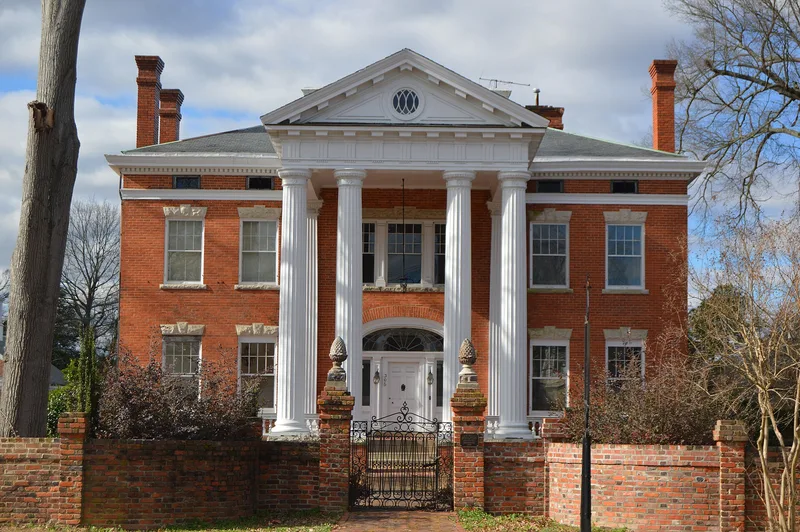
Machaven is a two-and-a-half-story brick house at 306 South Grace Street in Rocky Mount, completed in 1908 to designs by Raleigh architect Harry P. S. Keller. It has a hipped slate roof, a monumental portico with paired Doric columns, a fanlighted front door and a Palladian window on the Nash Street side. Inside, a central hall with a straight staircase serves rooms finished in Colonial Revival style, with classical mantels and cornices. A brick wall encloses the half-acre grounds, which include a formal garden and a former barn now used as a garage. James Williams Hines, an ice manufacturer and civic leader, built the house for his wife, Mary Matilda MacEntyre Hines, reportedly as a near replica of her family's home in Rutherfordton. Few of the large columned mansions that once lined Rocky Mount's residential streets survive. Machaven is valued as a well-preserved, documented example of that era, linked to the city's commercial growth and to an architect better known for later commercial and school buildings.
Significance in brief: The nomination calls it one of the very few surviving grand mansions built at the turn of the century for the businessmen who drove Rocky Mount's growth. It is a well-preserved, architect-designed example of Colonial and Neo-classical Revival domestic architecture. It is also tied to J. W. Hines, an ice manufacturer called the 'ice king' of the state, and to Keller.
Machine-generated summary. This summary was generated by a language model from the official nomination document and has not been reviewed line by line by an editor. It may contain errors. Check the source document before relying on any detail. Source: nomination document (PDF) · National Archives catalog entry. NRHP reference 80002890, listed November 25, 1980. Summary generated October 2026 (model claude-sonnet-5-5, prompt v1.0-2026-10-29, confidence high).
Key facts
| Official database NPS National Register database, ref. 80002890 , checked | |
|---|---|
| Address | 306, S. Grace St., Rocky Mount |
| County | Nash County |
| Listed | November 25, 1980 |
| Reference number | 80002890 |
| Resource type | Building |
| Areas of significance | Architecture |
| Level of significance | Local |
| National Historic Landmark | No |
| Acreage | 0.5 |
| Official document, machine-extracted Nomination form (National Archives) , checked | |
| Period of significance | 1908 |
| Architect / builder | Harry P. S. Keller |
| Architectural style | Neo-classical Revival / Colonial Revival |
| Criteria |
|
| Status (as stated in the nomination) | Described as in good condition, unaltered and on its original site, occupied as a private residence; changes to the structure have been insignificant. |
| Official dataset NPS cultural-resource GIS (NRHP locations) | |
| Coordinates | 35.94071, -77.80276 |
| Computed Computed from NPS GIS district boundaries | |
| Within district | Villa Place Historic District |
What listing means for this property
National Register listing is honorary: it recognises significance and does not restrict what a private owner may do without federal money or permits. It unlocks the 20% federal rehabilitation tax credit for income-producing buildings, state credits in many states, and Section 106 review when federal agencies are involved. See what listing means in practice.
General information, not legal or tax advice. Rules change; confirm with your State Historic Preservation Office or a qualified adviser.
Questions about Machaven
When was Machaven added to the National Register of Historic Places?
Machaven was listed on November 25, 1980. Its National Register reference number is 80002890.
Is Machaven a National Historic Landmark?
No. The National Park Service database (snapshot of May 2026) lists Machaven on the National Register but does not record it as a National Historic Landmark.
Where is Machaven?
306, S. Grace St., Rocky Mount, Nash County, North Carolina; coordinates 35.94071, -77.80276.
Why is Machaven historically significant?
According to a machine-generated summary of its nomination form: The nomination calls it one of the very few surviving grand mansions built at the turn of the century for the businessmen who drove Rocky Mount's growth. It is a well-preserved, architect-designed example of Colonial and Neo-classical Revival domestic architecture. It is also tied to J. W. Hines, an ice manufacturer called the 'ice king' of the state, and to Keller. Check the nomination document before relying on any detail.
Who designed or built Machaven?
The nomination form names Harry P. S. Keller as architect or builder (extracted by machine from the nomination; check the source document).
Is Machaven in a historic district?
Yes. Its location falls within the Villa Place Historic District, itself listed on the National Register. (Computed from National Park Service boundary data; the district nomination's own list of contributing resources may differ.)
Where can I read the original nomination for Machaven?
The nomination form is a public record held by the National Archives: nomination document (PDF).
Sources and further reading
- National Park Service, National Register of Historic Places database (snapshot May 2026), reference 80002890.
- Nomination form (PDF, National Archives) — catalog entry
- Wikipedia article (used for cross-checking only; text not reproduced here)
- Wikidata Q19986888
- This listing as JSON
Last updated November 2026. Found an error? See the editorial policy for how to report it.