Downtown Sanford Historic District (Boundary Increase and Decrease)

Why it's listed
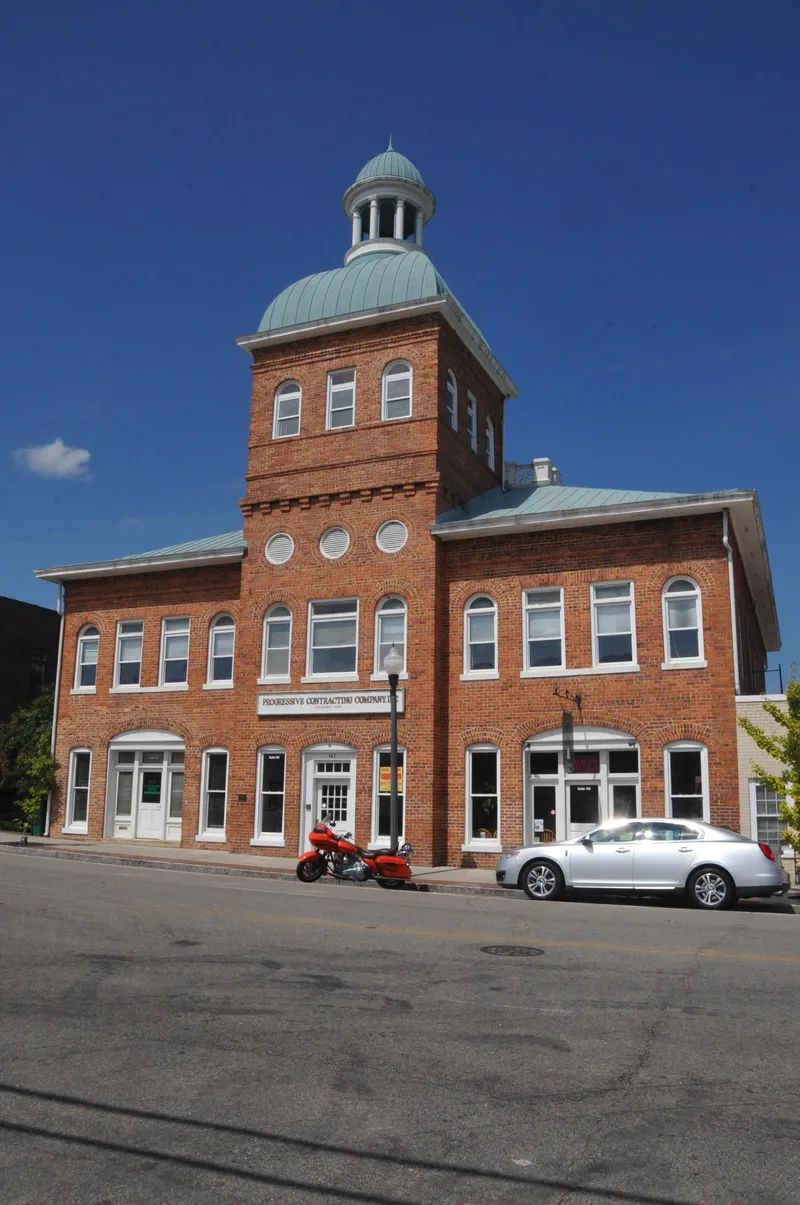
Downtown Sanford is a compact commercial district of about 96 structures covering roughly 36 acres in the center of the Lee County city. Sanford grew up because of the railroads, and the tracks still divide the older eastern section from the western blocks. Most development dates from a boom between about 1895 and 1930, producing one- to three-story masonry buildings set flush with the sidewalk, with decorative brick, stonework and molded terra cotta, reflecting the town's role as a brickmaking center. Landmarks include the Railroad House, a Gothic Revival cottage built for the first depot agent; the brick passenger depot; the 1910-era City Hall with its domed tower; the Masonic Lodge; the Temple Theater; the Carolina Hotel; and the six-story Wilrick Hotel, the tallest structure. Later infill is simpler, and some early facades have been covered with metal, stucco or permastone. The district still reads as a pre-World War II business center, and it remains the main retail area for the city and county.
Significance in brief: The district is the city's main retail center and preserves the look of a pre-World War II brick commercial downtown shaped by the railroads and the local brickmaking industry. Its buildings show decorative brickwork, terra cotta and stonework from the 1895-1930 boom, and it keeps much of the character it had by 1930.
Machine-generated summary. This summary was generated by a language model from the official nomination document and has not been reviewed line by line by an editor. It may contain errors. Check the source document before relying on any detail. Source: nomination document (PDF) · National Archives catalog entry. NRHP reference 100006819, listed August 16, 2021. Summary generated October 2026 (model claude-sonnet-5-5, prompt v1.0-2026-10-29, confidence medium).
Key facts
| Address | Roughly bounded by South Horner Blvd, Cole St., Maple Ave., South and North First Sts., Norfolk-Southern Railway tracks, Charlotte Ave., McIver St., North Moore St., Gordon St., Sanford |
|---|---|
| County | Lee County |
| Listed | August 16, 2021 |
| Reference number | 100006819 |
| Resource type | District |
| Architect / builder | Temple Theater designed by Henderson architect Eric G. Flanagan and built by the Joe W. Stout Company of Sanford |
| Architectural style | Late nineteenth and early twentieth century commercial architecture, with Gothic Revival, Spanish Mission, Art Deco, Tudor Revival and classical elements |
| Areas of significance | Commerce, Transportation, Exploration/Settlement, Politics/Government, Architecture, Ethnic Heritage-Black, Entertainment/Recreation, Social History |
| Level of significance | Local |
| Status (as stated in the nomination) | Mostly in commercial use; the district is in good to excellent condition, with some altered buildings and rehabilitation underway at the Temple Theater and Wilrick Hotel. |
| Acreage | 11.28 |
| Within district | Downtown Sanford Historic District (Additional Documentation) |
| Coordinates | 35.48030, -79.17830 (Wikidata) |
What listing means for this property
This is a historic district. Buildings within its boundary are either contributing (they add to the district's significance) or non-contributing. Owners of contributing income-producing buildings can claim the 20% federal rehabilitation tax credit; homeowners should look at state credits. National Register districts impose no design review by themselves; a local historic district ordinance, if one exists, does (the difference explained).
General information, not legal or tax advice. Rules change; confirm with your State Historic Preservation Office or a qualified adviser.
Sources and further reading
- National Park Service, National Register of Historic Places database (snapshot May 2026), reference 100006819.
- Nomination form (PDF, National Archives) — catalog entry
- Wikipedia article (used for cross-checking only; text not reproduced here)
- Wikidata Q19461396
- This listing as JSON
Last updated October 2026. Found an error? See the editorial policy for how to report it.