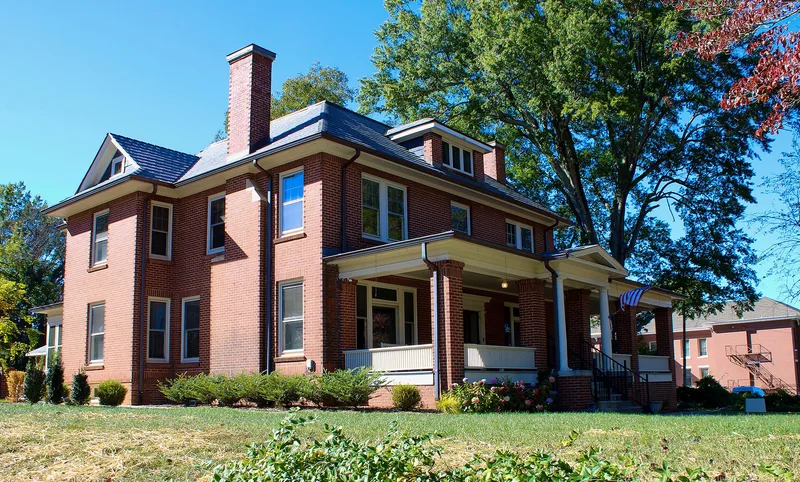
Long, Henry Fletcher and Carrie Allison, House
Long, Henry Fletcher and Carrie Allison, House is a building in Statesville, Iredell County, North Carolina, listed on the National Register of Historic Places on April 26, 2021 (reference number 100006460). The National Park Service records its significance in Architecture and Health/Medicine at the local level.
Facts from the NPS National Register database (). Last updated . Sources for each fact.

Approximate location: the National Park Service places this pin arbitrarily within the property, not at a surveyed point (stated accuracy ±12 m).
Why it's listed
No readable nomination text is available for this listing yet (nominations after 2012 are held by the National Park Service rather than the National Archives). The facts below come from the National Park Service database.
Key facts
| Official database NPS National Register database, ref. 100006460 , checked | |
|---|---|
| Address | 335 North Center St., Statesville |
| County | Iredell County |
| Listed | April 26, 2021 |
| Reference number | 100006460 |
| Resource type | Building |
| Areas of significance | Architecture, Health/Medicine |
| Level of significance | Local |
| National Historic Landmark | No |
| Acreage | 1.08 |
| Official dataset NPS cultural-resource GIS (NRHP locations) | |
| Coordinates | 35.78886, -80.89091 |
What listing means for this property
National Register listing is honorary for a privately owned home: it does not by itself restrict what an owner may do with their own money, and it does not require public access. Restrictions come from local landmark or historic-district ordinances, which are separate (how they differ).
Owner-occupied houses are not eligible for the 20% federal rehabilitation tax credit, which applies to income-producing buildings, but many states offer credits for homeowners. Listing also opens the door to preservation easements and to buying a plaque. Start with what listing means for homeowners, renovating a listed house and selling one.
General information, not legal or tax advice. Rules change; confirm with your State Historic Preservation Office or a qualified adviser.
Sources and further reading
- National Park Service, National Register of Historic Places database (snapshot May 2026), reference 100006460.
- Wikipedia article (used for cross-checking only; text not reproduced here)
- Wikidata Q123376248
- This listing as JSON
Last updated November 2026. Found an error? See the editorial policy for how to report it.