Fields, William, House

Why it's listed
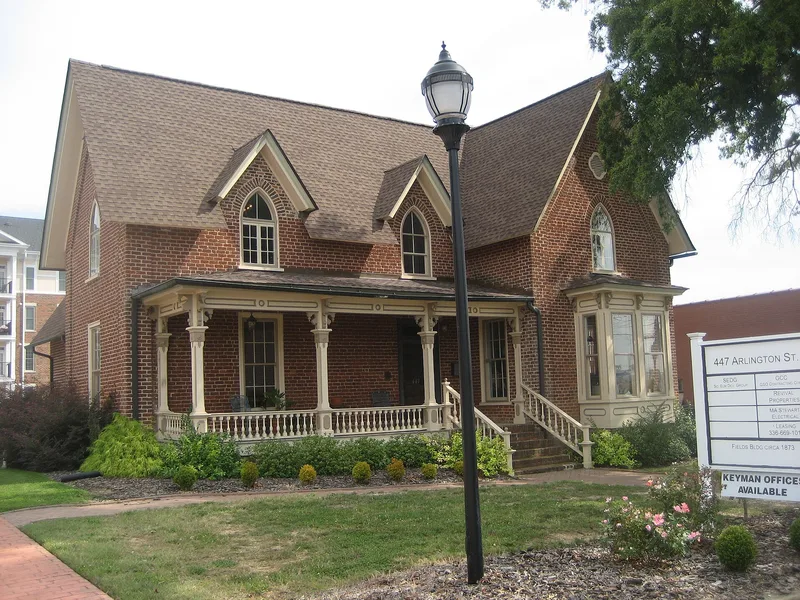
Built between 1875 and 1879 at 447 Arlington Street, this one-and-a-half story brick cottage was home to William Fields, a tobacco manufacturer. Its T-shaped plan, steep gables, wall dormers, lancet-arched upper windows, quatrefoil vents and bracketed bay window follow the Gothic Revival cottage style popularized by Andrew Jackson Downing. Local tradition attributes it, without documentation, to architect Lyndon Swaim, who is also linked to two other brick Gothic houses in the city. The house is one of very few mid-19th century buildings left in Greensboro and a rare North Carolina example of its style. It also reflects the growth of the city's middle class after the Civil War, near the Shieldstown residential development. Later it served as a church parsonage and then an antique shop. Sandblasting and chemical paint removal in 1979 damaged woodwork and brick, but the building keeps its original form and details. A preservation society now owns it and planned repairs.
Significance in brief: The house is a rare North Carolina example of the Downingesque Gothic cottage and one of only a few mid-19th century buildings left in Greensboro. It retains its original form and stylistic details despite harsh surface treatments in 1979. It is also associated with the post-Civil War growth of Greensboro and its emerging middle class.
Machine-generated summary. This summary was generated by a language model from the official nomination document and has not been reviewed line by line by an editor. It may contain errors. Check the source document before relying on any detail. Source: nomination document (PDF) · National Archives catalog entry. NRHP reference 85003084, listed December 5, 1985. Summary generated October 2026 (model claude-sonnet-5-5, prompt v1.0-2026-10-29, confidence high).
Key facts
| Address | 447 Arlington St., Greensboro |
|---|---|
| County | Guilford County |
| Listed | December 5, 1985 |
| Reference number | 85003084 |
| Resource type | Building |
| Architect / builder | Unknown; possibly Lyndon Swaim of Greensboro (attribution undocumented) |
| Architectural style | Gothic Revival (Downingesque Gothic cottage) |
| Criteria |
|
| Areas of significance | Commerce, Architecture, Social History |
| Level of significance | Local |
| Status (as stated in the nomination) | Owned by a preservation society that plans to use it as offices and a meeting space; the form says it stood vacant for several years after an antique shop closed, and exterior and interior repairs were being planned. |
| Acreage | 0.9 |
| Coordinates | 36.06508, -79.78898 (NPS GIS) |
What listing means for this property
National Register listing is honorary for a privately owned home: it does not by itself restrict what an owner may do with their own money, and it does not require public access. Restrictions come from local landmark or historic-district ordinances, which are separate (how they differ).
Owner-occupied houses are not eligible for the 20% federal rehabilitation tax credit, which applies to income-producing buildings, but many states offer credits for homeowners. Listing also opens the door to preservation easements and to buying a plaque. Start with what listing means for homeowners, renovating a listed house and selling one.
General information, not legal or tax advice. Rules change; confirm with your State Historic Preservation Office or a qualified adviser.
Sources and further reading
- National Park Service, National Register of Historic Places database (snapshot May 2026), reference 85003084.
- Nomination form (PDF, National Archives) — catalog entry
- Wikipedia article (used for cross-checking only; text not reproduced here)
- Wikidata Q19461737
- This listing as JSON
Last updated October 2026. Found an error? See the editorial policy for how to report it.