Black, George, House and Brickyard

Why it's listed
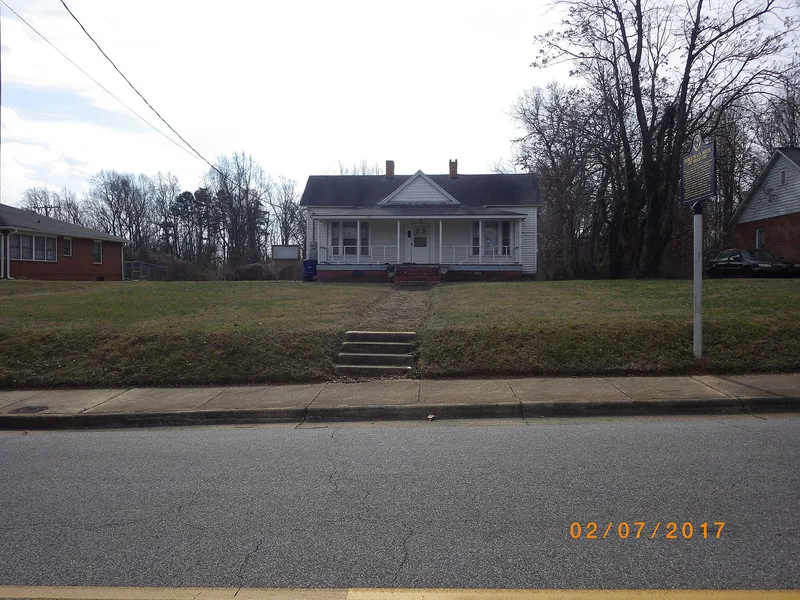
On Dellabrook Road in eastern Winston-Salem stands a modest one-story frame house, built about 1900 in the common "triple-A" form, with a false center gable decorated with fishscale shingles. Behind it, in a wooded area, lie the remains of a brickyard, including a mud mill site, scattered brick piles and the outline of a kiln. George H. Black, son of a former slave, bought the property in 1934 and lived here until his death in 1980 at age 101. He kept molding and firing bricks by hand while other brickmakers switched to machines, and his bricks were used in Winston-Salem's finer buildings and in restoration work at Colonial Williamsburg and Old Salem. The property was listed for its association with the traditional handmade brick industry and with Black himself, and for the archaeological information the kiln and mill remains could provide. The house still serves as a residence, and the brickyard site is largely intact despite road grading to the south.
Significance in brief: George H. Black lived and worked here from 1934 until his death in 1980, making bricks by hand long after machines became standard. The property is argued to be significant for its link to the traditional hand-molded brick industry and to Black, a nationally recognized brickmaker. The surviving kiln and mud mill remains are also considered likely to yield information about brickmaking technology.
Machine-generated summary. This summary was generated by a language model from the official nomination document and has not been reviewed line by line by an editor. It may contain errors. Check the source document before relying on any detail. Source: nomination document (PDF) · National Archives catalog entry. NRHP reference 99001683, listed January 28, 2000. Summary generated October 2026 (model claude-sonnet-5-5, prompt v1.0-2026-10-29, confidence high).
Key facts
| Address | 111 Dellabrook Rd., Winston-Salem |
|---|---|
| County | Forsyth County |
| Listed | January 28, 2000 |
| Reference number | 99001683 |
| Resource type | Building |
| Period of significance | 1934-1980 |
| Architect / builder | Black, George H. (brickyard) |
| Architectural style | OTHER: Triple-A |
| Criteria |
|
| Areas of significance | Industry, Historic - Non-Aboriginal |
| Level of significance | National |
| Status (as stated in the nomination) | The house remains in Black family ownership and is used year-round as a rental residence. The brickyard remains are overgrown and partly below ground, but the site's integrity is described as high despite road grading. |
| Acreage | 0.9 |
| Coordinates | 36.11341, -80.20956 (NPS GIS) |
What listing means for this property
National Register listing is honorary for a privately owned home: it does not by itself restrict what an owner may do with their own money, and it does not require public access. Restrictions come from local landmark or historic-district ordinances, which are separate (how they differ).
Owner-occupied houses are not eligible for the 20% federal rehabilitation tax credit, which applies to income-producing buildings, but many states offer credits for homeowners. Listing also opens the door to preservation easements and to buying a plaque. Start with what listing means for homeowners, renovating a listed house and selling one.
General information, not legal or tax advice. Rules change; confirm with your State Historic Preservation Office or a qualified adviser.
Sources and further reading
- National Park Service, National Register of Historic Places database (snapshot May 2026), reference 99001683.
- Nomination form (PDF, National Archives) — catalog entry
- Wikipedia article (used for cross-checking only; text not reproduced here)
- Wikidata Q19460545
- This listing as JSON
Last updated October 2026. Found an error? See the editorial policy for how to report it.