Arista Cotton Mill Complex
Also known as: Lentz Transfer & Storage Co.

Why it's listed
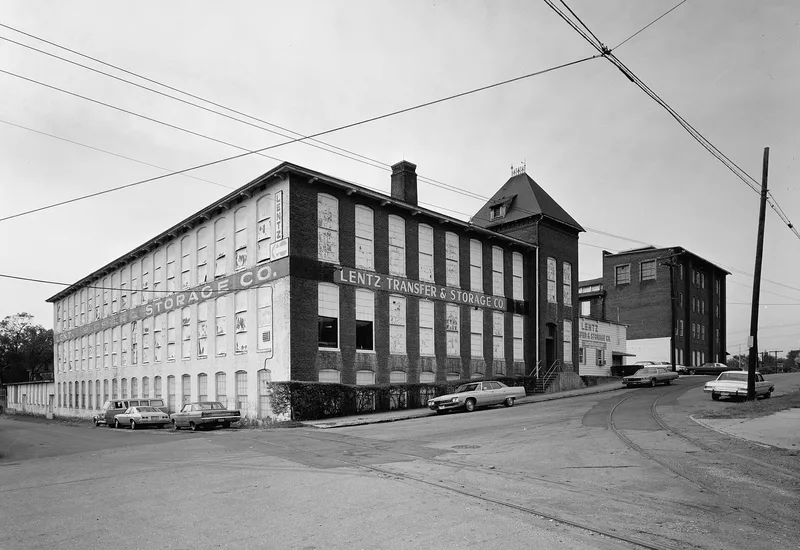
Two brick mill buildings and a small transformer station on Brookstown Avenue in Winston-Salem preserve the city's early textile industry. The older building dates to 1836, when Salem businessmen, including Francis Levan Fries, organized a cotton manufacturing company. It later became the Wachovia Flour Mills after the Fries brothers took control in 1856. The second building, the Arista Cotton Mill, was built in 1880 under Francis H. Fries. It is a three-story, fourteen-bay brick structure with a stair tower, and it was among the first Southern mills to use electric lights. It operated until the mid-1920s and employed about 150 workers at the time of a 1915 report. A transformer station from 1899 supplied power to the complex and other local users. The site shows how Salem moved from handicraft weaving to mass production, and it records the Fries family's part in the region's industry, banking and railroads. The old flour mill still serves as a warehouse.
Significance in brief: The complex is presented as the oldest physical reminder of Winston-Salem's textile foundations, of Salem's shift from craft production to mass manufacturing, and of the Fries family's role in industry, banking and transportation. It challenges the view that the city's growth rested only on tobacco.
Machine-generated summary. This summary was generated by a language model from the official nomination document and has not been reviewed line by line by an editor. It may contain errors. Check the source document before relying on any detail. Source: nomination document (PDF) · National Archives catalog entry. NRHP reference 77000999, listed August 18, 1977. Summary generated October 2026 (model claude-sonnet-5-5, prompt v1.0-2026-10-29, confidence medium).
Key facts
| Address | 200 Brookstown Ave., Winston-Salem |
|---|---|
| County | Forsyth County |
| Listed | August 18, 1977 |
| Reference number | 77000999 |
| Resource type | Building |
| Period of significance | 1800-1899 |
| Architect / builder | Francis H. Fries supervised construction of the 1880 Arista mill; the 1836 mill was built by part of the Moravian congregation of Salem. |
| Areas of significance | Industry |
| Level of significance | State |
| Status (as stated in the nomination) | Occupied; the former Wachovia Flour Mills building continues in use as a warehouse for a transfer and storage company. Several related structures (ice plant, cotton warehouse, power station, gas works) have been demolished. |
| Acreage | 0.9 |
| Coordinates | 36.09011, -80.24578 (NPS GIS) |
What listing means for this property
For an income-producing building, listing (individually or as a contributing building in a district) is the gateway to the 20% federal rehabilitation tax credit on qualified rehabilitation costs, often stackable with state credits. Work claiming the credit must follow the Secretary of the Interior's Standards and be approved in advance.
Listing does not restrict a private owner acting without federal money or permits; where federal funding or licensing is involved, Section 106 review applies.
General information, not legal or tax advice. Rules change; confirm with your State Historic Preservation Office or a qualified adviser.
Sources and further reading
- National Park Service, National Register of Historic Places database (snapshot May 2026), reference 77000999.
- Nomination form (PDF, National Archives) — catalog entry
- Wikipedia article (used for cross-checking only; text not reproduced here)
- Wikidata Q18739418
- This listing as JSON
Last updated October 2026. Found an error? See the editorial policy for how to report it.