Leigh Farm

Why it's listed
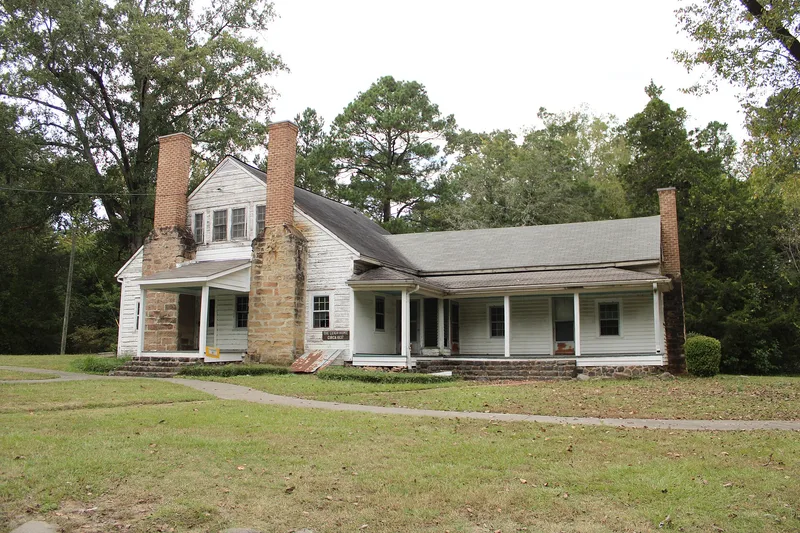
Leigh Farm, east of Chapel Hill, is a modest nineteenth-century farm complex in a quiet rural setting. A one-story, three-bay frame house with a broad gable roof, wide pine interior sheathing and two stone-based chimneys stands among log and frame outbuildings: a corn crib, carriage house, dairy, smokehouse and two log dwellings said to have been slave quarters. Richard Stanford Leigh received the 500-acre tract in 1834, and the house was probably built soon after. By 1860 he held nearly a thousand acres and sixteen slaves. The family later suffered losses when Union troops passed through in 1865, and Leigh turned to a sawmill and store. The farm matters as a representative middle-class plantation that still holds tools, products and papers of rural Southern life. Its most unusual feature is a log slave house, later a weaving house, with a log and stick chimney, a type known in only two other recorded North Carolina examples.
Significance in brief: The nomination argues the farm is a complete, representative example of the moderate-sized farm that made up much of nineteenth-century North Carolina, and of the state's middle class of small planters. It also holds notable outbuildings, including a tiny frame dairy and log structures with four types of corner timbering. One former slave house has a log and stick chimney, a rare survival in the state.
Machine-generated summary. This summary was generated by a language model from the official nomination document and has not been reviewed line by line by an editor. It may contain errors. Check the source document before relying on any detail. Source: nomination document (PDF) · National Archives catalog entry. NRHP reference 75001257, listed September 5, 1975. Summary generated October 2026 (model claude-sonnet-5-5, prompt v1.0-2026-10-29, confidence high).
Key facts
| Address | E of Chapel Hill off NC 54, Chapel Hill |
|---|---|
| County | Durham County |
| Listed | September 5, 1975 |
| Reference number | 75001257 |
| Resource type | Building |
| Period of significance | 1800-1899 |
| Areas of significance | Agriculture, Architecture |
| Level of significance | Local |
| Status (as stated in the nomination) | Described as in good condition; the house was restored in 1950 and the log chimney is noted as in excellent condition. |
| Acreage | 20 |
| Coordinates | 35.92213, -78.98254 (NPS GIS) |
What listing means for this property
National Register listing is honorary for a privately owned home: it does not by itself restrict what an owner may do with their own money, and it does not require public access. Restrictions come from local landmark or historic-district ordinances, which are separate (how they differ).
Owner-occupied houses are not eligible for the 20% federal rehabilitation tax credit, which applies to income-producing buildings, but many states offer credits for homeowners. Listing also opens the door to preservation easements and to buying a plaque. Start with what listing means for homeowners, renovating a listed house and selling one.
General information, not legal or tax advice. Rules change; confirm with your State Historic Preservation Office or a qualified adviser.
Sources and further reading
- National Park Service, National Register of Historic Places database (snapshot May 2026), reference 75001257.
- Nomination form (PDF, National Archives) — catalog entry
- Wikipedia article (used for cross-checking only; text not reproduced here)
- Wikidata Q19986772
- This listing as JSON
Last updated October 2026. Found an error? See the editorial policy for how to report it.