Durham Hosiery Mill

Why it's listed
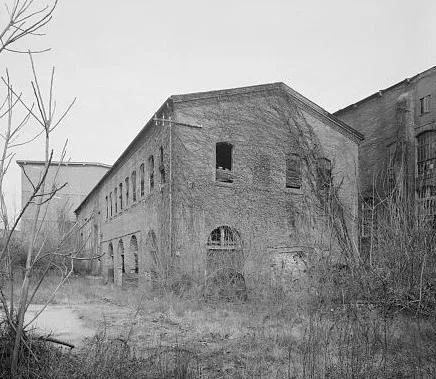
Red brick mill buildings along Angier Avenue in East Durham make up the first plant of the Durham Hosiery Mills Corporation. The four-story main building, finished in 1902, has a six-story tower with Romanesque-arched brickwork, and it was joined by a dye house, engine and boiler houses, three annexes built between 1904 and 1912, and a later finishing building. Julian S. Carr, a tobacco industrialist, led the company to diversify his interests, and the mill anchored the Edgemont mill village. By 1910 the corporation was the world's largest maker of cotton hosiery, and its Durable Durham brand became widely known. The company later opened a mill staffed entirely by black workers and tried an employee representation plan after 1919. The Angier Avenue mill was abandoned in 1922, then served as a Red Cross site, tobacco storage and a warehouse. The complex was listed as a well-preserved example of mill construction and for its place in the industrial history of Durham and the Piedmont.
Significance in brief: The mill was the original plant of the Durham Hosiery Mills Corporation, which by 1910 was the world's largest manufacturer of cotton hosiery. It is described as one of the finest surviving examples of mill construction in North Carolina. It is also tied to tobacco industrialist Julian S. Carr and to the textile side of Durham's industrial growth.
Machine-generated summary. This summary was generated by a language model from the official nomination document and has not been reviewed line by line by an editor. It may contain errors. Check the source document before relying on any detail. Source: nomination document (PDF) · National Archives catalog entry. NRHP reference 78001944, listed November 14, 1978. Summary generated October 2026 (model claude-sonnet-5-5, prompt v1.0-2026-10-29, confidence high).
Key facts
| Address | Angier Ave., Durham |
|---|---|
| County | Durham County |
| Listed | November 14, 1978 |
| Reference number | 78001944 |
| Resource type | Building |
| Period of significance | 1900- |
| Criteria |
|
| Areas of significance | Industry, Commerce, Architecture |
| Level of significance | National |
| Status (as stated in the nomination) | Condition listed as fair; buildings structurally sound but many windows bricked in, broken or missing. Part used for commercial storage and a flea market; the rest of the buildings were empty at the time of nomination. |
| Acreage | 4.2 |
| Coordinates | 35.98886, -78.89238 (NPS GIS) |
What listing means for this property
For an income-producing building, listing (individually or as a contributing building in a district) is the gateway to the 20% federal rehabilitation tax credit on qualified rehabilitation costs, often stackable with state credits. Work claiming the credit must follow the Secretary of the Interior's Standards and be approved in advance.
Listing does not restrict a private owner acting without federal money or permits; where federal funding or licensing is involved, Section 106 review applies.
General information, not legal or tax advice. Rules change; confirm with your State Historic Preservation Office or a qualified adviser.
Sources and further reading
- National Park Service, National Register of Historic Places database (snapshot May 2026), reference 78001944.
- Nomination form (PDF, National Archives) — catalog entry
- Wikipedia article (used for cross-checking only; text not reproduced here)
- Wikidata Q18739426
- This listing as JSON
Last updated October 2026. Found an error? See the editorial policy for how to report it.