Fayetteville Women's Club and Oval Ballroom

Why it's listed
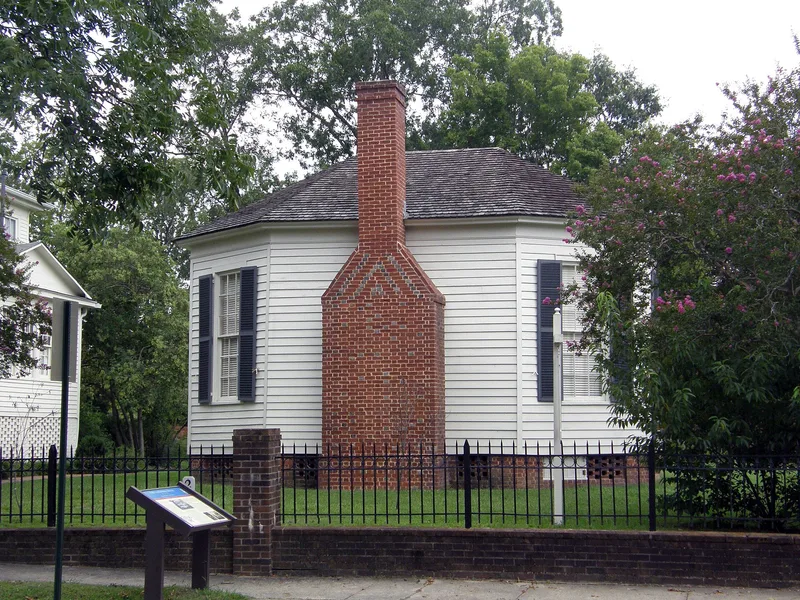
Heritage Square in Fayetteville holds two linked buildings on Dick Street: a large Federal town house and a small oval ballroom. The frame house, probably built soon after 1798 by merchant Duncan McLeran, has a two-story columned porch, a Palladian doorway with delicate Federal detail, and Victorian additions made in the late nineteenth century. From 1820 it served as the North Carolina office of the Bank of the United States, with the vault in the basement. Later it was the adolescent home of painter Elliott Daingerfield. The Oval Ballroom, an elongated octagon about twenty by thirty feet, is traditionally dated to 1830 and was moved from beside the Halliday house, since demolished. Its interior has fluted Ionic pilasters and an elaborate plaster cornice and ceiling medallion, making it one of the finest Adam-style rooms in the state. Both buildings are maintained by the local women's club.
Significance in brief: The house was once the North Carolina office of the Bank of the United States and later the home of painter Elliott Daingerfield, and it has notable Federal exterior woodwork overlaid with Victorian changes. The Oval Ballroom is described as one of the finest examples of the Adam style in North Carolina, with exceptional plaster ornament. Together with the nearby Nimocks House, they represent fine Federal architecture in nineteenth-century Fayetteville.
Machine-generated summary. This summary was generated by a language model from the official nomination document and has not been reviewed line by line by an editor. It may contain errors. Check the source document before relying on any detail. Source: nomination document (PDF) · National Archives catalog entry. NRHP reference 73001330, listed February 6, 1973. Summary generated October 2026 (model claude-sonnet-5-5, prompt v1.0-2026-10-29, confidence high).
Key facts
| Address | 224 Dick St., Fayetteville |
|---|---|
| County | Cumberland County |
| Listed | February 6, 1973 |
| Reference number | 73001330 |
| Resource type | Building |
| Period of significance | after 1798-before 1815 |
| Architect / builder | Duncan McLeran (probable builder of the house) |
| Architectural style | Federal with Victorian alterations; Adam style (Oval Ballroom) |
| Areas of significance | Commerce, Art, Architecture |
| Level of significance | State |
| Status (as stated in the nomination) | The club maintains the house in excellent repair. Its basement is used for meetings and the upper floors are rented to young working women. The ballroom was moved to its present site and preserved. |
| Acreage | 1 |
| Coordinates | 35.04828, -78.87799 (NPS GIS) |
What listing means for this property
National Register listing is honorary: it recognises significance and does not restrict what a private owner may do without federal money or permits. It unlocks the 20% federal rehabilitation tax credit for income-producing buildings, state credits in many states, and Section 106 review when federal agencies are involved. See what listing means in practice.
General information, not legal or tax advice. Rules change; confirm with your State Historic Preservation Office or a qualified adviser.
Sources and further reading
- National Park Service, National Register of Historic Places database (snapshot May 2026), reference 73001330.
- Nomination form (PDF, National Archives) — catalog entry
- Wikipedia article (used for cross-checking only; text not reproduced here)
- Wikidata Q5739051
- This listing as JSON
Last updated October 2026. Found an error? See the editorial policy for how to report it.