Kenworth Historic District
Kenworth Historic District is a historic district in Hickory, Catawba County, North Carolina, listed on the National Register of Historic Places on May 9, 1985 (reference number 85001054). The National Park Service records its significance in Community Planning and Development and Architecture at the local level.
Facts from the NPS National Register database (); nomination summary October 2026. Last updated . Sources for each fact.

Approximate location: the National Park Service places this pin arbitrarily within the property, not at a surveyed point (stated accuracy ±12 m).
Why it's listed
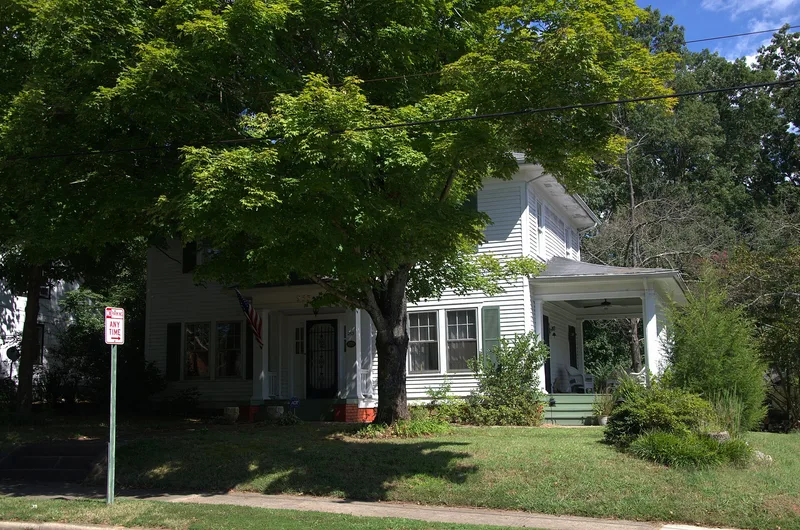
Kenworth Historic District is a compact neighborhood of twenty-three main buildings on roughly nine acres in southeast Hickory. It occupies the northwest corner of the original Kenworth subdivision, the city's first, and was built almost entirely between about 1920 and 1926. Fifth Street, entered between paired stone piers off Second Avenue, is its principal street. About seventy percent of the buildings are bungalows, and the group is described as the most varied and impressive collection of the type in Hickory. The houses share similar setbacks, lot sizes, gabled porches, exposed purlin brackets, tapered porch posts and stone or brick foundations suited to the sloping terrain. Other buildings include three Colonial Revival houses, the 1913 Kenworth Elementary School, and the 1926 Neo-Gothic former Christ Lutheran Church, now Mount Zion Baptist Church. The district was listed because its buildings form a cohesive, intact group that contrasts with the newer development around it.
Significance in brief: The district is described as Hickory's finest and most varied collection of bungalows, which make up about seventy percent of its buildings. The houses are visually cohesive in scale, siting, materials and detail, and they show how the city's first subdivision developed in a short span of time. The district also includes a 1913 school, a 1926 Neo-Gothic church and three Colonial Revival houses.
Machine-generated summary. This summary was generated by a language model from the official nomination document and has not been reviewed line by line by an editor. It may contain errors. Check the source document before relying on any detail. Source: nomination document (PDF) · National Archives catalog entry. NRHP reference 85001054, listed May 9, 1985. Summary generated October 2026 (model claude-sonnet-5-5, prompt v1.0-2026-10-29, confidence medium).
Key facts
| Official database NPS National Register database, ref. 85001054 , checked | |
|---|---|
| Address | Roughly bounded by 2nd Ave., 5th St. and 3rd Ave. Dr. SE, Hickory |
| County | Catawba County |
| Listed | May 9, 1985 |
| Reference number | 85001054 |
| Resource type | District |
| Areas of significance | Community Planning and Development, Architecture |
| Level of significance | Local |
| National Historic Landmark | No |
| Acreage | 9 |
| Official document, machine-extracted Nomination form (National Archives) , checked | |
| Architectural style | Bungalow, with Colonial Revival houses and a Neo-Gothic Revival church |
| Status (as stated in the nomination) | Condition is marked as good, fair and deteriorated, and altered and unaltered. The former Christ Lutheran Church is now Mount Zion Baptist Church, rededicated in 1979. Most buildings are private residences. |
| Official dataset NPS cultural-resource GIS (NRHP locations) | |
| Coordinates | 35.72786, -81.32909 |
| Computed Computed from NPS GIS district boundaries | |
| Within district | Kenworth Historic District (Boundary Increase) |
What listing means for this property
This is a historic district. Buildings within its boundary are either contributing (they add to the district's significance) or non-contributing. Owners of contributing income-producing buildings can claim the 20% federal rehabilitation tax credit; homeowners should look at state credits. National Register districts impose no design review by themselves; a local historic district ordinance, if one exists, does (the difference explained).
General information, not legal or tax advice. Rules change; confirm with your State Historic Preservation Office or a qualified adviser.
Questions about Kenworth Historic District
When was Kenworth Historic District added to the National Register of Historic Places?
Kenworth Historic District was listed on May 9, 1985. Its National Register reference number is 85001054.
Is Kenworth Historic District a National Historic Landmark?
No. The National Park Service database (snapshot of May 2026) lists Kenworth Historic District on the National Register but does not record it as a National Historic Landmark.
Where is Kenworth Historic District?
Roughly bounded by 2nd Ave., 5th St. and 3rd Ave. Dr. SE, Hickory, Catawba County, North Carolina; coordinates 35.72786, -81.32909.
Why is Kenworth Historic District historically significant?
According to a machine-generated summary of its nomination form: The district is described as Hickory's finest and most varied collection of bungalows, which make up about seventy percent of its buildings. The houses are visually cohesive in scale, siting, materials and detail, and they show how the city's first subdivision developed in a short span of time. The district also includes a 1913 school, a 1926 Neo-Gothic church and three Colonial Revival houses. Check the nomination document before relying on any detail.
Is Kenworth Historic District in a historic district?
Yes. Its location falls within the Kenworth Historic District (Boundary Increase), itself listed on the National Register. (Computed from National Park Service boundary data; the district nomination's own list of contributing resources may differ.)
Where can I read the original nomination for Kenworth Historic District?
The nomination form is a public record held by the National Archives: nomination document (PDF).
Sources and further reading
- National Park Service, National Register of Historic Places database (snapshot May 2026), reference 85001054.
- Nomination form (PDF, National Archives) — catalog entry
- Wikipedia article (used for cross-checking only; text not reproduced here)
- Wikidata Q18153104
- This listing as JSON
Last updated November 2026. Found an error? See the editorial policy for how to report it.