Hunting Creek Railroad Bridge

Why it's listed
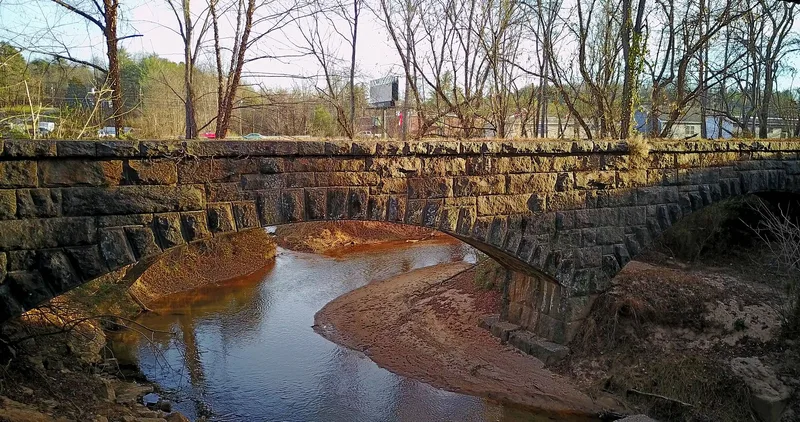
Spanning Hunting Creek just north of Highway 64-70 in Morganton, this two-span stone railroad bridge dates to about 1860, when the Western North Carolina Railroad was preparing to extend from Salisbury to Morganton and on toward Asheville. Construction halted with the Civil War, and trains did not use the line until about 1868. The bridge is 130 feet long, stands about 24 feet above the creek, and carries an eight-foot-wide stone bed on arches of rusticated, coursed ashlar with stone voussoirs. It was abandoned when locomotives grew too heavy for it and was replaced by later bridges, including an iron one built in 1910 almost directly above it. The form suggests contractor William Murdoch may have built it, though records do not confirm this. It was listed as a rare surviving stone railroad bridge, notable for its engineering and as the earliest surviving reminder of the railroad's push into western North Carolina.
Significance in brief: The nomination argues the bridge is a rare surviving antebellum stone railroad bridge and among the oldest surviving railroad structures in the state. It is believed to be the earliest surviving resource tied to extending the Western North Carolina Railroad westward. It is also significant in engineering for its construction technique.
Machine-generated summary. This summary was generated by a language model from the official nomination document and has not been reviewed line by line by an editor. It may contain errors. Check the source document before relying on any detail. Source: nomination document (PDF) · National Archives catalog entry. NRHP reference 87001923, listed November 9, 1987. Summary generated October 2026 (model claude-sonnet-5-5, prompt v1.0-2026-10-29, confidence high).
Key facts
| Address | Hunting Creek N of US 64 & 70 between jct. of Stonebridge Rd. & E. Union St., Morganton |
|---|---|
| County | Burke County |
| Listed | November 9, 1987 |
| Reference number | 87001923 |
| Resource type | Structure |
| Period of significance | ca. 1860 - ca. 1890 |
| Architect / builder | Unknown (may be the work of contractor William Murdoch) |
| Criteria |
|
| Areas of significance | Engineering, Transportation |
| Level of significance | State |
| Status (as stated in the nomination) | Abandoned and unoccupied; track removed but the structure is described as completely intact and appearing solid. Relatively inaccessible, with dense underbrush around it. |
| Acreage | 0.1 |
| Coordinates | 35.75157, -81.65836 (NPS GIS) |
What listing means for this property
For a publicly owned building or structure, listing mainly matters when federal funds, permits or licences are involved: projects then go through Section 106 review so effects on the property are considered. Listing also strengthens applications for preservation grants and, for leased income-producing uses, can enable the federal rehabilitation tax credit.
Noted as vacant in the nomination. Nomination documents can be decades old; current status may differ. If you are considering buying an empty listed property, read the due-diligence checklist.
General information, not legal or tax advice. Rules change; confirm with your State Historic Preservation Office or a qualified adviser.
Sources and further reading
- National Park Service, National Register of Historic Places database (snapshot May 2026), reference 87001923.
- Nomination form (PDF, National Archives) — catalog entry
- Wikipedia article (used for cross-checking only; text not reproduced here)
- Wikidata Q18152121
- This listing as JSON
Last updated October 2026. Found an error? See the editorial policy for how to report it.