Avery Avenue School
Also known as: Catawba Valley Legal Services
Avery Avenue School is a building in Morganton, Burke County, North Carolina, listed on the National Register of Historic Places on November 9, 1987 (reference number 87001925). The National Park Service records its significance in Education and Architecture at the local level.
Facts from the NPS National Register database (); nomination summary October 2026. Last updated . Sources for each fact.

Approximate location: the National Park Service places this pin arbitrarily within the property, not at a surveyed point (stated accuracy ±12 m).
Why it's listed
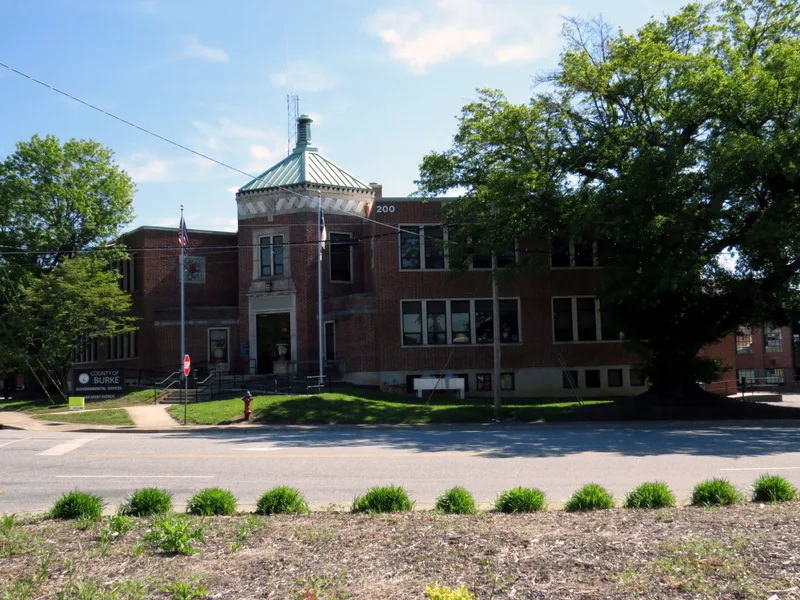
Built in 1923 at the corner of Avery Avenue and Bouchelle Street, this two-story brick school was the first separate high school building in Morganton. It is believed to have been designed by Charles Christian Hook, a prominent Charlotte architect. The crescent-shaped building has a polygonal center section with a pyramidal mission-tile roof and a small belfry, flanked by flat-roofed wings. Ornament includes acanthus-leaf cornice detailing, zigzag mosaic friezes, multicolored mosaic panels, terra cotta heraldic symbols and corner urns. School officials chose to build a new high school rather than enlarge the 1906 graded school, recognizing that older students had different needs. Rapid population growth filled the building within a few years, and a larger high school opened in 1926. Avery Avenue School then housed elementary classes until 1957, followed by county offices and, from 1982, a legal services office. Although the interior and windows were altered, the exterior still conveys its distinctive design, and it is the oldest surviving educational building in the city.
Significance in brief: It was Morganton's first separate high school building, reflecting a progressive decision to serve secondary students apart from the graded school. It is the oldest surviving educational building in the city. Its unusual polygonal center section and eclectic ornamentation also make it architecturally distinctive, and it is believed to be the work of a prominent Charlotte architect.
Machine-generated summary. This summary was generated by a language model from the official nomination document and has not been reviewed line by line by an editor. It may contain errors. Check the source document before relying on any detail. Source: nomination document (PDF) · National Archives catalog entry. NRHP reference 87001925, listed November 9, 1987. Summary generated October 2026 (model claude-sonnet-5-5, prompt v1.0-2026-10-29, confidence high).
Key facts
| Official database NPS National Register database, ref. 87001925 , checked | |
|---|---|
| Address | 200 Avery Ave., Morganton |
| County | Burke County |
| Listed | November 9, 1987 |
| Reference number | 87001925 |
| Resource type | Building |
| Areas of significance | Education, Architecture |
| Level of significance | Local |
| National Historic Landmark | No |
| Acreage | 0.9 |
| Official document, machine-extracted Nomination form (National Archives) , checked | |
| Period of significance | ca. 1923 - 1926 |
| Architect / builder | believed to be Charles Christian Hook |
| Architectural style | Highly eclectic; the form says it defies placement in a stylistic category |
| Criteria |
|
| Status (as stated in the nomination) | Used as a school until 1957, then converted to county offices; renovated in 1982 for a legal services office, which occupies it. The second floor was being renovated for additional office space. Interior completely remodeled and modern tinted windows installed. |
| Official dataset NPS cultural-resource GIS (NRHP locations) | |
| Coordinates | 35.74798, -81.68708 |
What listing means for this property
For a publicly owned building or structure, listing mainly matters when federal funds, permits or licences are involved: projects then go through Section 106 review so effects on the property are considered. Listing also strengthens applications for preservation grants and, for leased income-producing uses, can enable the federal rehabilitation tax credit.
General information, not legal or tax advice. Rules change; confirm with your State Historic Preservation Office or a qualified adviser.
Questions about Avery Avenue School
When was Avery Avenue School added to the National Register of Historic Places?
Avery Avenue School was listed on November 9, 1987. Its National Register reference number is 87001925.
Is Avery Avenue School a National Historic Landmark?
No. The National Park Service database (snapshot of May 2026) lists Avery Avenue School on the National Register but does not record it as a National Historic Landmark.
Where is Avery Avenue School?
200 Avery Ave., Morganton, Burke County, North Carolina; coordinates 35.74798, -81.68708.
Why is Avery Avenue School historically significant?
According to a machine-generated summary of its nomination form: It was Morganton's first separate high school building, reflecting a progressive decision to serve secondary students apart from the graded school. It is the oldest surviving educational building in the city. Its unusual polygonal center section and eclectic ornamentation also make it architecturally distinctive, and it is believed to be the work of a prominent Charlotte architect. Check the nomination document before relying on any detail.
Who designed or built Avery Avenue School?
The nomination form names believed to be Charles Christian Hook as architect or builder (extracted by machine from the nomination; check the source document).
Where can I read the original nomination for Avery Avenue School?
The nomination form is a public record held by the National Archives: nomination document (PDF).
Sources and further reading
- National Park Service, National Register of Historic Places database (snapshot May 2026), reference 87001925.
- Nomination form (PDF, National Archives) — catalog entry
- Wikipedia article (used for cross-checking only; text not reproduced here)
- Wikidata Q17985689
- This listing as JSON
Last updated November 2026. Found an error? See the editorial policy for how to report it.