Downtown Asheville Historic District (Boundary Increase)
Also known as: Biltmore Avenue Amendment; See Also:Downtown Asheville Histor
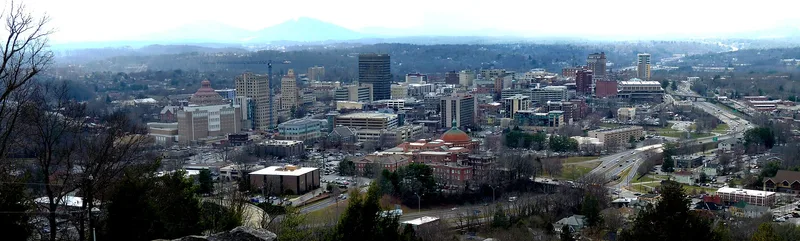

Why it's listed
Two adjoining two-story brick buildings at 60 and 64 Biltmore Avenue in downtown Asheville were added to the existing historic district. Both date to 1925, during the city's 1920s building boom. Number 60 was built as the Burlington Hotel, serving the tourist trade, and later became the Princeton Hotel around 1935. Its ground floor held shops, including the New York Cafe and Sterchies Furniture Exchange. Its brick facade has three bays, granite bases and sills, and an ornate terra cotta cornice with egg-and-dart molding. Number 64 is a simpler painted brick building with corbelled brickwork. It housed auto-related businesses such as battery and parts shops. It had suffered vacancy, deterioration and vandalism before being rehabilitated for offices. The buildings were added because they are physically and historically connected to the district, which is described as containing the finest collection of late nineteenth and early twentieth century urban architecture in North Carolina.
Significance in brief: The two buildings are said to contribute to the period and areas of significance stated in the 1978 nomination for the Downtown Asheville Historic District. They represent the 1920s building boom, and 60 Biltmore Avenue served the tourist trade as the Burlington Hotel. They sit on land physically and developmentally contiguous with the existing district.
Machine-generated summary. This summary was generated by a language model from the official nomination document and has not been reviewed line by line by an editor. It may contain errors. Check the source document before relying on any detail. Source: nomination document (PDF) · National Archives catalog entry. NRHP reference 89000468, listed May 25, 1989. Summary generated October 2026 (model claude-sonnet-5-5, prompt v1.0-2026-10-29, confidence medium).
Key facts
| Address | 60 and 64 Biltmore Ave., Asheville |
|---|---|
| County | Buncombe County |
| Listed | May 25, 1989 |
| Reference number | 89000468 |
| Resource type | District |
| Architectural style | Late 19th and Early 20th Century American Movements/Commercial Style |
| Areas of significance | Commerce, Architecture |
| Level of significance | State |
| Status (as stated in the nomination) | 60 Biltmore Avenue has been rehabilitated inside for modern office use; 64 Biltmore Avenue was vacant, deteriorated and vandalized, and was being rehabilitated for office space. |
| Acreage | 0.9 |
| Within district | Downtown Asheville Historic District |
| Coordinates | 35.59261, -82.55093 (NPS GIS) |
What listing means for this property
This is a historic district. Buildings within its boundary are either contributing (they add to the district's significance) or non-contributing. Owners of contributing income-producing buildings can claim the 20% federal rehabilitation tax credit; homeowners should look at state credits. National Register districts impose no design review by themselves; a local historic district ordinance, if one exists, does (the difference explained).
General information, not legal or tax advice. Rules change; confirm with your State Historic Preservation Office or a qualified adviser.
Sources and further reading
- National Park Service, National Register of Historic Places database (snapshot May 2026), reference 89000468.
- Nomination form (PDF, National Archives) — catalog entry
- Wikipedia article (used for cross-checking only; text not reproduced here)
- Wikidata Q18149496
- This listing as JSON
Last updated October 2026. Found an error? See the editorial policy for how to report it.