Oak Island Life Saving Station

Why it's listed
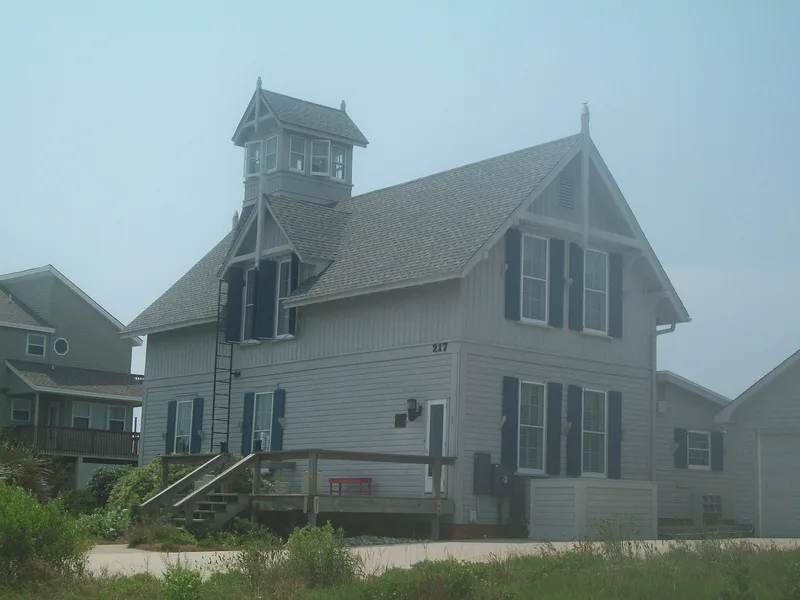
Oak Island Life Saving Station is a one-and-one-half story frame building on Caswell Beach Road, near the mouth of the Cape Fear River. Built in 1889 to the U.S. Life Saving Service's 1882 prototype design, probably by architect J. Lake Parkinson, it has a front-gable form, kingpost trusses, board-and-batten and German siding, and a rooftop lookout tower. Congress authorized the station in 1886 after deadly shipwrecks near Frying Pan Shoals. Keeper Dunbar Davis, who served from 1891 to 1915, led volunteers in rescuing five schooners during an August 1893 hurricane. The station was decommissioned in 1932, when a Coast Guard station replaced it, and was sold about 1938, moved across the road, and converted to a summer cottage. Alterations were modest: the boat doors became windows and a rear shed was added. The original floor plan and much interior finish survive. It is recognized for its role in North Carolina maritime history and as the most intact 1880s station in the state.
Significance in brief: It is one of the most intact of North Carolina's fifteen surviving life saving stations and the southernmost one, authorized to improve rescue capability near Frying Pan Shoals. It is significant under Criterion A for North Carolina maritime history, including keeper Dunbar Davis's 1893 rescue of five schooners. It is significant under Criterion C as the most architecturally intact 1880s station in the state.
Machine-generated summary. This summary was generated by a language model from the official nomination document and has not been reviewed line by line by an editor. It may contain errors. Check the source document before relying on any detail. Source: nomination document (PDF) · National Archives catalog entry. NRHP reference 00001553, listed December 28, 2000. Summary generated October 2026 (model claude-sonnet-5-5, prompt v1.0-2026-10-29, confidence high).
Key facts
| Address | 217 Caswell Beach Rd., Caswell Beach |
|---|---|
| County | Brunswick County |
| Listed | December 28, 2000 |
| Reference number | 00001553 |
| Resource type | Building |
| Period of significance | ca. 1889-ca. 1938 |
| Architect / builder | Parkinson, J. Lake |
| Architectural style | Stick/Eastlake |
| Criteria |
|
| Areas of significance | Maritime History, Architecture |
| Level of significance | State |
| Status (as stated in the nomination) | Used as a private summer cottage since the late 1930s; the interior retains its original floor plan and finishes. |
| Acreage | 0.4 |
| Coordinates | 33.89173, -78.03322 (NPS GIS) |
What listing means for this property
For an income-producing building, listing (individually or as a contributing building in a district) is the gateway to the 20% federal rehabilitation tax credit on qualified rehabilitation costs, often stackable with state credits. Work claiming the credit must follow the Secretary of the Interior's Standards and be approved in advance.
Listing does not restrict a private owner acting without federal money or permits; where federal funding or licensing is involved, Section 106 review applies.
General information, not legal or tax advice. Rules change; confirm with your State Historic Preservation Office or a qualified adviser.
Sources and further reading
- National Park Service, National Register of Historic Places database (snapshot May 2026), reference 00001553.
- Nomination form (PDF, National Archives) — catalog entry
- Wikipedia article (used for cross-checking only; text not reproduced here)
- Wikidata Q18155276
- This listing as JSON
Last updated October 2026. Found an error? See the editorial policy for how to report it.